

To assess whether different products can share one heat treatment furnace, Jiangsu Suneng Industrial Furnace Co., Ltd. recommends checking whether their process schedules, loading arrangements and fixtures (structures that support, locate or carry workpieces), atmosphere (the process gas environment inside the furnace) or cooling conditions, changeover operations and quality criteria fall within the same set of verifiable limits. The same furnace type, or enough chamber space, does not by itself establish suitability. If a change affects equipment loading, the thermal cycle, transfer or acceptance criteria, those conditions must be reconfirmed before changing production. Acceptance records for the previous product cannot simply be applied to the next one.
Separate “sharing a furnace” into three questions
When a buyer asks about processing multiple products in one furnace, they may be asking three different questions:
- Can the equipment support and handle the load? Check whether the workpieces, fixtures and loading arrangement remain within the confirmed limits of the equipment, conveying system, supports and transfer equipment.
- Can the same process controls be used? Check whether the temperature schedule, soaking, speed, atmosphere, cooling and transfer after discharge remain applicable.
- Can quality be accepted on the same basis? Confirm the critical product requirements, measurement locations, records and acceptance criteria for each product.
Passing the first check does not automatically satisfy the other two. Record separate conclusions and evidence for “can be handled,” “can be processed under these conditions” and “can be accepted against this evidence.”
Build a product–process–loading matrix first
Instead of starting with “How many products can this furnace process?”, put each product into the same comparison table:
| Check | Question to ask | Evidence to retain |
|---|---|---|
| Product and material | After changes in material, shape, thickness or surface requirements, is heating and cooling behavior still within the known range? | Product list, drawings or photographs, material specifications and quality requirements |
| Process schedule | Have temperature, soaking, conveying speed, atmosphere, cooling or transfer after discharge changed? | Process sheets, curves, recipe versions and change records |
| Loading and fixtures | Have piece count, total weight, supports, spacing, stacking or fixture weight changed? | Loading diagrams, load lists, fixture drawings and load-capacity calculations |
| Changeover operations | Does the change require line clearance, replacement fixtures, program changes, waiting for downstream equipment or manual intervention? | Changeover steps, interlocks, waiting areas and first-piece confirmation records |
| Acceptance criteria | Are measurement locations, sampling, appearance and performance criteria the same for different products? | Inspection plans, record templates and jointly confirmed acceptance conditions |
The matrix turns furnace sharing into a set of conditions that can be checked individually. It is not a new universal acceptance standard. The project process documents, technical agreement and acceptance plan remain the governing basis.
Which changes require reconfirmation?
The following changes should at least trigger a targeted review, with renewed process or equipment validation where necessary:
- Changes in material, critical dimensions, thickness or shape that affect heating, cooling or support conditions;
- Changes in temperature, soaking time, conveying speed, atmosphere, cooling method or transfer after discharge;
- Changes in fixtures, support points, orientation, load quantity, spacing between adjacent parts or fixture weight;
- Changes in program recipes or versions, alarms and interlocks, sensors or critical control logic;
- Changes in upstream or downstream handling, transfer timing, line clearance, changeover steps or manual intervention;
- Changes in quality requirements, measurement locations, sampling, records or the scope of customer acceptance.
A program change alone cannot resolve all these issues because the furnace retains a thermal and atmosphere history:
- Atmosphere change involves residual gas and gas replacement. Gas in the chamber, retort or other vessels and pipework, together with any residues or deposits, does not disappear the instant a program changes. Before starting a different atmosphere process, gas replacement, cleaning, stabilization and confirmation of the actual atmosphere may be needed under the applicable furnace and project documents. No universal number of conditioning cycles or waiting time is assumed here. The method depends on the equipment, atmosphere and agreed documentation.
- The lining and furnace structure store heat. After a high-temperature process, the lining, structure and associated metal components retain heat. They may continue releasing heat into the chamber after the setpoint is lowered. Reaching the next process temperature therefore does not necessarily mean conditions have stabilized. Changeover time must include actual cooling and stabilization, as well as program changes, when assessing quality, production scheduling and cycle time.
- Fixtures also have a thermal history. A fixture that fits inside the furnace is not necessarily in the same usable condition after different temperatures, atmospheres, heating and cooling cycles or soaking times. Its history may affect distortion risk, surface condition, support stability and maintenance needs. Reconfirm fixture suitability within the project limits when changing products; do not apply a universal service-life figure across projects.
Changeover direction is usually not symmetrical. Heating actively adds energy, while a change from a higher to a lower temperature depends on stored heat, heat dissipation and whether the equipment provides controlled cooling. Where atmosphere, fixtures, line clearance, quality requirements and upstream and downstream conditions permit, and temperature change is the main source of changeover time, scheduling lower-temperature work before higher-temperature work within a production sequence can generally reduce waiting for the furnace to cool and stabilize again. Conversely, if the product mix frequently requires high-to-low temperature changes, procurement questions must go beyond maximum temperature and heating rate: ask how cooling is achieved, how long it takes to reach the next process range, and how stabilization is established. If this time directly affects capacity, include cooling and stabilization curves under the relevant conditions in cycle-time checks or acceptance. Forced cooling is not a mandatory feature for every project; the need depends on changeover frequency, process limits and equipment conditions.
“Reconfirmation” does not just mean “try it again.” First identify the affected conditions, then decide whether first-piece confirmation, loaded process validation, or changes to the technical agreement and acceptance plan are needed.
Manage changeovers using three levels of change
A project can use three working levels to coordinate purchasing, process, equipment and quality teams:
1. Conditions are unchanged: use the established changeover procedure
The product, fixtures, loading, program version and quality criteria remain within the confirmed range, and changeover involves only validated operations. Continue recording the batch, program version and first-piece result.
2. Basic equipment limits are unchanged: confirm the affected items
Equipment loading and the basic process remain within their limits, but there are local changes in product, loading or processing. Depending on the change, arrange line clearance, fixture replacement, program checks, first-piece checks or other targeted confirmation. If the result does not satisfy the conditions, do not treat the whole batch as validated.
3. The core thermal cycle or quality criteria change: revalidate
When temperature schedules, soaking, atmosphere or cooling change substantially, or fixture support, load distribution, transfer or acceptance requirements have changed, validate the new combination. Previous records can inform the review but cannot replace evidence for the new conditions.
These levels are a project-management framework, not a fixed classification for every furnace. The depth of validation depends on process risk, product requirements and the agreed documents.
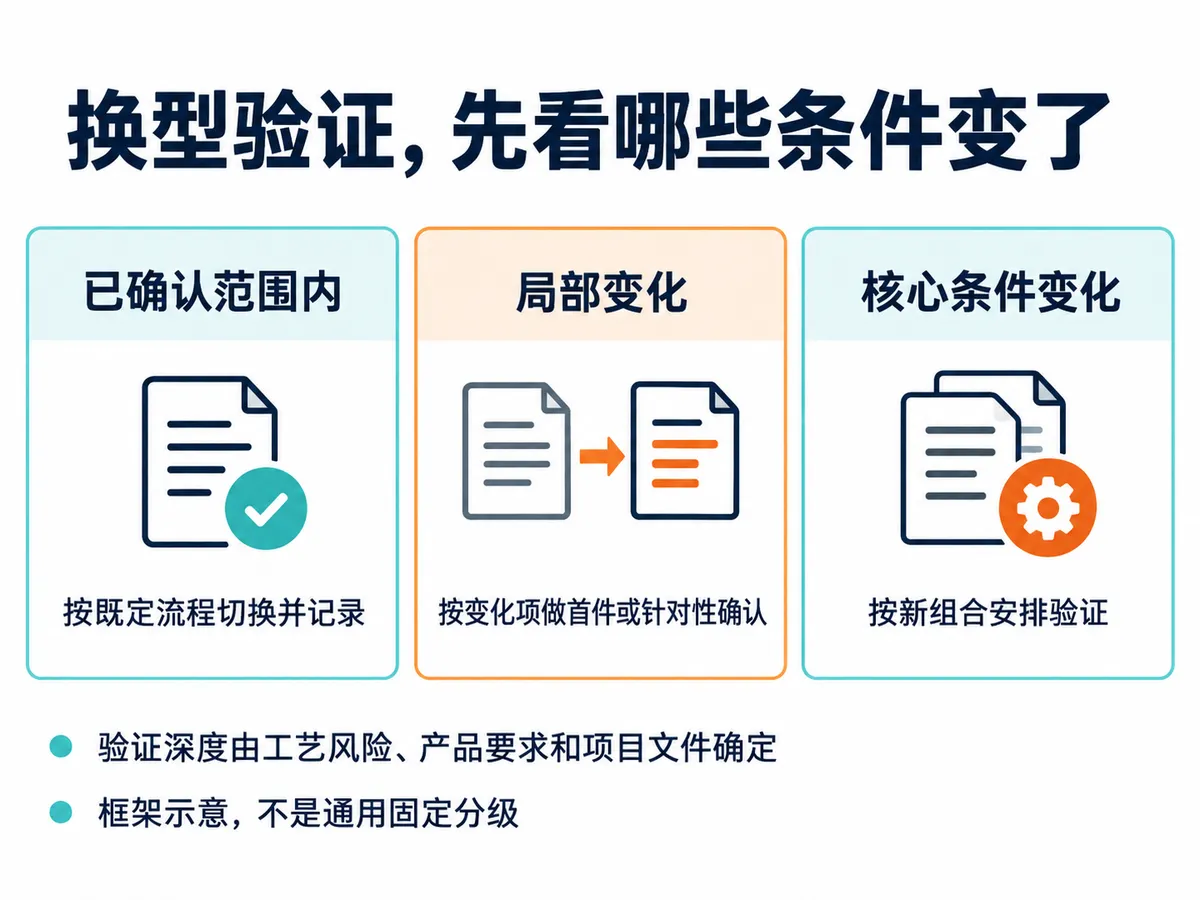
Changeover management diagram. A local change assumes that equipment loading and the basic process remain within their limits. Process risk, product requirements and agreed documents determine validation depth. Diagram labels are in Chinese; the three levels are explained above in English.
Do not validate only the easiest product
A validation plan can prioritize representative situations:
- A stable, well-documented representative product as the baseline;
- A product more sensitive to loading, heating, cooling or transfer, to test the relevant limits;
- A first piece or representative condition after an actual changeover, to confirm line clearance, fixture replacement, recipe selection and complete records.
For every validation, identify the product and process versions, fixtures and loading arrangement, target cycle time, shift, alarms and interruptions. Record changeovers, planned stops, energy or upstream/downstream interruptions and program changes separately. Agree in advance which circumstances require timing to pause, another first-piece check or revalidation of the affected operation.
Four common mistakes when sharing one furnace
- “The furnace type is the same, so all products can share it.” A furnace type describes a structure; it does not replace product, process and acceptance conditions.
- “It fits in the chamber, so the process is feasible.” Geometric space is not the same as effective space for heating, cooling and transfer.
- “One empty-furnace run proves suitability for multiple products.” An empty run reveals only some equipment functions and cannot replace validation with actual fixtures and loads.
- “Just copy the previous product’s recipe.” Once recipe version, loading or quality criteria change, copying does not constitute confirmation.
Define the sharing limits before procurement
Prepare a product list; materials and drawings or photographs; process sheets and versions for each product; loading diagrams and fixture information; pieces and total weight per batch; shifts and changeover frequency; upstream and downstream interfaces; acceptance requirements; and existing abnormal-event records. Mark missing information for confirmation rather than asking a supplier to guess.
Jiangsu Suneng Industrial Furnace Co., Ltd. can use this information for an initial assessment of whether the products fall within the same equipment’s usable range, which changes require first-piece confirmation or revalidation, and which limits remain undefined in the technical agreement. This assessment does not replace formal process qualification, measurement calibration, product inspection, regulatory requirements or the signed technical agreement. Safety, environmental and product-standard conditions remain subject to applicable documents.
To request an initial document review, provide the product and process information above and identify the request as “Multi-product furnace process-changeover limits.”
Telephone: +86-130-5298-6814
Email: 997518512@qq.com
Website: https://www.jssngyl.cn
Basis and scope: The judgments in this article rely on general thermal principles, equipment-interface relationships and procurement/acceptance management logic. Unverified historical project documents are not presented as public factual evidence. Equipment, process and acceptance conclusions must be based on formal project documents.