

Because there is enough water flowing through the main pipe, it does not mean that every water-using part has been cooled as needed. When multiple furnaces share cooling water, it is necessary to check the actual flow rate of each branch, the water supply and return pressure conditions at the equipment interface, and whether the inlet water temperature meets the requirements of each equipment at the same time. The total flow rate is just one of them.
Jiangsu Suneng Industrial Furnace Co., Ltd. A plan of the furnace group water cooling system, and at the same time lists the water parts, cooling units, main pipes and branch pipes of different equipment. To check the cooling water capacity, you should also look down along the "cooling station - pipe network - water-using parts", and should not end at the pump parameters.
This article discusses the cooling and water supply of furnace components and supporting equipment, and does not discuss the process parameters of workpiece tank quenching.
Equal header flow can conceal unequal branch flows
At the same time, when the flow is almost stable, the change in water density is negligible, and there is no bypass, water leakage or obvious change in water storage within the statistical range, the main pipeline flow rate should correspond to the sum of the flow rates of each branch route counted. However,The total amount to meet the demand does not mean that every branch road meets the demand.
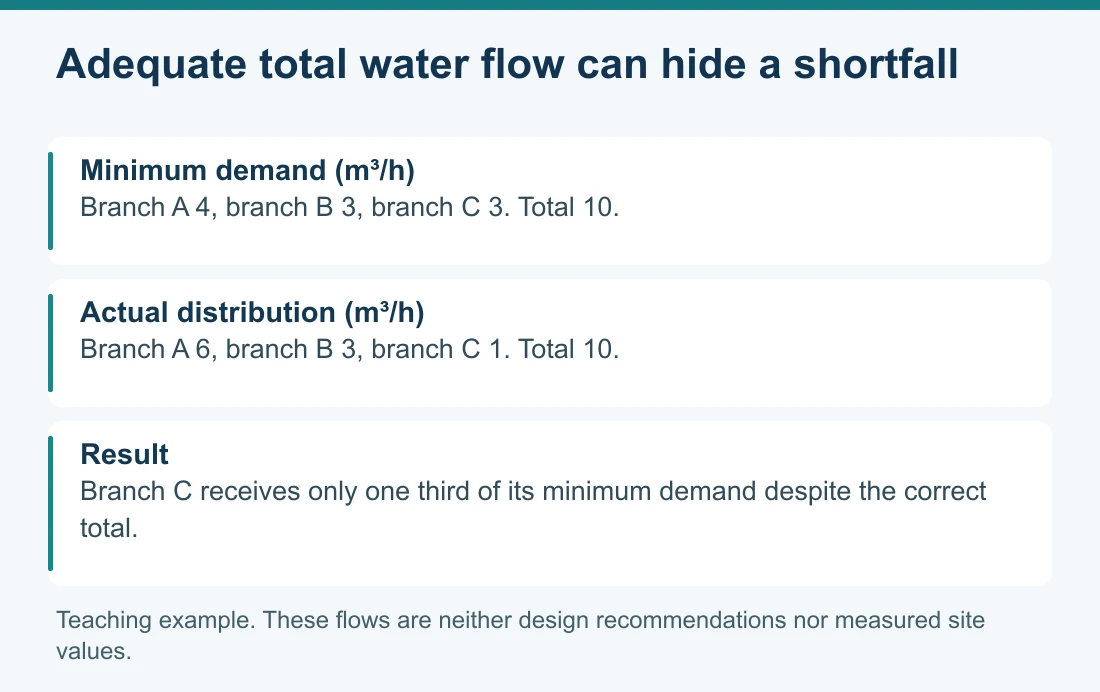
The following is the teaching hypothesis to explain the distribution relationship. It is not the actual measurement data of Suneng equipment, nor the recommended flow rate of any device. Assuming that the minimum demand for the three branch roads has been determined by the requirements of each equipment:
| Use the water branch road | Assuming the minimum demand | Assuming the actual distribution | The actual minus the minimum demand |
|---|---|---|---|
| First of the ten Heavenly Stems | 4 cubic meters/hour | 6 cubic meters/hour | 2 cubic meters more/hour |
| Second of the ten Heavenly Stems | 3 cubic meters/hour | 3 cubic meters/hour | Same |
| Third of the ten Heavenly Stems | 3 cubic meters/hour | 1 cubic meter/hour | 2 cubic meters less/hour |
| Amount to | 10 cubic meters/hour | 10 cubic meters/hour | Same |
The general table seems to meet exactly 10 cubic meters/hour, but the C branch only gets one-third of the minimum demand. The amount of water that is excessed by Branch Road A cannot replace the amount of water that is missing from Branch Road C on the book. This example only tests the distribution relationship, and the maximum flow, pressure and temperature allowed by each device must be satisfied separately.
Therefore, in addition to the general management record, there should also be a branch record under the corresponding operation combination for water supply acceptance. Only a total flow rate is provided, which cannot prove that all water-using parts are sufficiently cooled.
Pump nameplate flow and installed system flow can differ
After the pump is connected to the pipe network, how much water can actually be delivered is related to the performance of the pump and the resistance of the pipeline. Pipe diameter, length, elbow, filter, valve part and internal channel of the equipment will all affect the resistance that needs to be overcome when the water flows through.
The "lift" in the pump data can be understood as the mechanical energy increased by the pump to the water per unit weight, which is usually expressed in meters; it should be seen with the flow rate, and cannot be understood only by the vertical height of the site. The supplier should check the actual operating point, that is, the flow and lift that can be provided at the same time after the pump is connected to the pipe network. Description of pump and system operation point
After multiple devices are connected at the same time, the resistance of different branches is different, and the flow is not necessarily distributed equally according to the number of devices. Insufficient water supply of a branch road may involve the total water supply capacity, branch road distribution or local resistance; if you can't see the lack of cooling, you can directly determine the need for a larger pump.
In particular, if only one furnace was originally brought and equipment was added later, it should be re-checked according to the new simultaneous operation combination. The original pump can still be turned, the main pipe and there is still water, which cannot prove that the new branch line has met the requirements.
Warm inlet water can limit cooling even at adequate flow
The cooling water needs to receive the heat of the equipment. In addition to sufficient flow, it also needs appropriate water intake temperature and heat exchange conditions. When other conditions are similar, the temperature of the inlet water may increase, which may reduce the temperature difference between the cooled parts and the water that can be used for heat exchange; the supporting heat exchanger should also check the temperature and flow rate on both sides. Description of heat transfer temperature difference and influencing factors
Therefore, the same branch flow may correspond to different cooling effects when the water supply temperature of the cooling station is different. The temperature range in the unit parameters must also correspond to the requirements of the actual water-using equipment, and cannot be used as a unified applicable value for all furnace models.
When checking, the water supply temperature of the cooling station, the inlet temperature of the equipment and the necessary return water or component temperature records should be obtained at the same time. If the temperature of the equipment is abnormal, the water supply temperature, branch flow and heat load of the equipment should be compared at the same time before it can be judged whether it is the overall change of water supply, the insufficiency of a certain branch, or the change of the heat exchange conditions of the equipment itself.
The "heat load" here refers to the heat that the part needs to be taken away by the cooling system per unit of time. The total flow rate meets the standard, which cannot replace this check.
Record each demand point before purchase or expansion
| Check the object | At least what information is obtained? | What is used to judge? |
|---|---|---|
| Each water-using part | The flow rate, inlet temperature, water supply and return pressure conditions and interface specified by the equipment | What are the conditions for this branch road? |
| Run the combination at the same time | Which equipment or parts will use water at the same time, and how does the demand change with the process stage? | Total demand and operation combination that needs to be verified |
| Main pipe and branch road | Pipeline layout, pump performance information, corresponding actual water supply records in the operating state | Can the water be delivered to each interface as required? |
| Cooling unit | Water supply conditions that can be maintained under the agreed on-site environment and heat load | Can multiple devices continue to receive heat when running? |
| Supply handover point | Who is responsible for the unit, the main pipe, the branch pipe in front of the furnace, and the connection on the furnace respectively? | What are the connections and verifications after "the water has been delivered to the furnace"? |
Among them, the last paragraph is the most likely to be omitted. The scheme says "support pipe to the front of the furnace", which does not automatically mean that the pipeline, components and measurement conditions of the front furnace interface to each water-using part have been included. This junction point is not clear. Even if the parameters of the cooling unit are correct, the equipment may lack checkable water supply conditions.
On-site inspection and adjustment should be carried out by the corresponding professionals in accordance with the procedures confirmed by the equipment; the allocation example in this article is not used to set the protection value, nor to cancel or change the necessary cooling.
If you need to evaluate the new construction or expansion of the cooling water of the furnace group, you can provide the water requirements for equipment, the information of the existing pump and cooling unit, the arrangement of the general branch pipe, the simultaneous operation plan, and the existing flow and temperature records. Jiangsu Suneng Industrial Furnace Co., Ltd. Accordingly, it can assist in distinguishing the total capacity, branch route allocation, water supply temperature and on-site handover problems, and then determine the content that needs to be recalculated and verified.
Technical author: 苏能工业炉工程技术团队&唐荔 (Suneng Industrial Furnace Engineering Team & Tang Li)
Tel: +86-130-5298-6814
Email:997518512@qq.com
Official website:https://www.jssngyl.cn/en