

For indirect equipment, only after confirming that the limitation comes from the effective heating capacity, and verifying that the heat exchanger, circulating air channel and supporting system can undertake the new heat, can the burner be increased.. Jiangsu Suneng Industrial Furnace Co., Ltd. is suggested to distinguish between "heat is not sent into the furnace" and "heat enters the furnace but is not transmitted to the workpiece as required". Both of them will show full-load slow heating, but the processing direction is different.
This article mainly focuses on the indirect gas curing furnace with heat exchanger. The combustion products of the direct heating equipment enter the working area without going through the isolated heat exchange link described in the article; the verification ideas of wind channel and loading can be used for reference, but the heat exchanger diagnosis is not applicable, and the exhaust, combustion and protection requirements must be rechecked according to the specific equipment. This article does not provide the general curing temperature or heating speed.
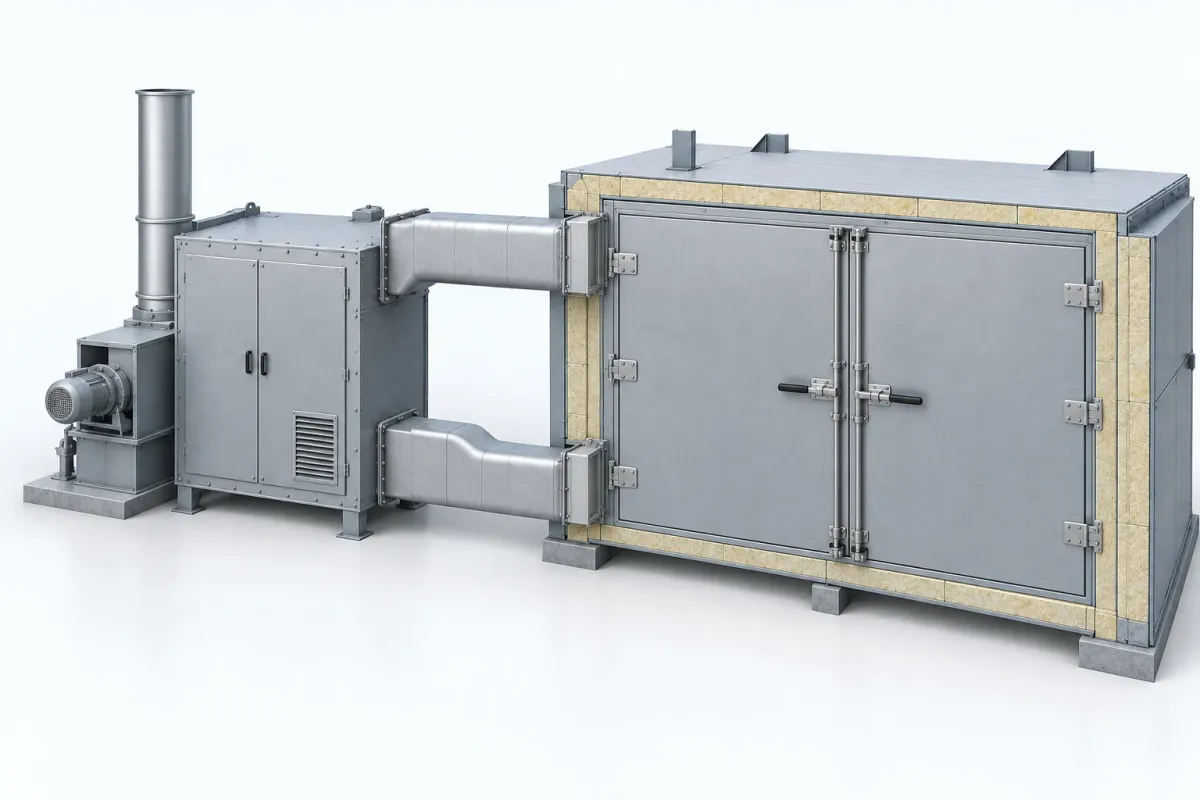
The appearance concept of indirect heating and curing equipment is indicated by non-project real shooting; the specific heat exchange structure, air path and configuration shall be subject to the actual equipment information.
Trace heat transfer from the burner to the workpiece
The main heat transfer path of the indirect equipment discussed in this article is:
Fuel heat dissipation → heat exchanger → circulating air → working area with gas cylinder → workpiece.
The rated capacity of the burner is not equal to the actual heating power obtained by the workpiece. The heat transfer capacity of the heat exchanger, the air-side flow, the heat dissipation of the pipe and the furnace, the heat taken away by the exhaust air, and the heat absorption of the workpiece and fixtures will all affect the final curve.
Therefore, before choosing a larger burner, you should first answer: Does the existing system continue to achieve the allowed heating output? Can the heat be transferred to the circulating air through the heat exchanger? Does the air delivery pass through the workpiece area that needs to be heated? If the problem occurs in the last two sections and only the fuel input is increased, it may still not be able to eliminate the heating lag of the workpiece.
More circulating air does not necessarily deliver more heat
The circulating wind is responsible for transporting heat and organizing airflow. The air volume and the temperature difference of the return wind should be seen together, and you can't just compare the fan nameplate.
For the same cycle branch, under the condition that the mass flow of the return wind is approximately equal and the air state can be similar to the visible heat relationship, the net heat rate of air brought into the working area can be understood in the following way:
The net heat power carried by the air ≈ air mass flow × average specific heat × (sending air temperature - return air temperature).
The air quality flow rate is kg/second, the average specific heat is kilojole/(kg·°C), and the temperature difference is °C. The result is kilowatts. The measurement position and time of the return wind must correspond; when there is obvious mixed wind, diversion or exhaust wind, the calculation range should be delimited according to the actual wind path first.
This shows that:The air volume and temperature difference together determine how much heat the air carries, but not all of these heat will become the heat absorption of the workpiece.. Part of it is also used to heat up the furnace body, fixtures and other objects, or for heat dissipation and exhaust loss. The above values cannot be written directly as the effective power of workpiece.
If the data is the volumetric air volume, it is also necessary to confirm the corresponding air temperature, pressure and measurement conditions. The nominal air volume of the fan is not equal to the actual operating air volume after connecting to the heat exchanger and air channel and completing the loading.
Compare temperature trends to locate the bottleneck
First, verify the reliability of the measurement record, and compare the bottle type, loading, fixtures, initial temperature, target curve and measurement points of the comparison batch. Then align the curve of the heat exchange section, the return air, the space in the furnace and the representative workpiece with the heating output, circulation and exhaust air states.
| Observed performance | What should be checked first? | Impact on "whether to add power" |
|---|---|---|
| The heating continues to be at the allowable high output, and the air delivery, the space in the furnace and the workpiece are all lagging behind. | Actual heat load, effective heating, heat exchanger capacity and heat dissipation exhaust loss | It is necessary to continue to account whether the heating supply is insufficient; high output alone cannot exclude excessive losses or limited heat exchange. |
| The temperature on the heat source side of the heat exchange section is already high, and the heating of the air supply is still weak. | Heat transfer status of heat exchanger, actual air flow rate and bypass | The heat transfer bottleneck should be checked first. Increasing the burner may not be able to send more heat into the working area. |
| The air delivery and some space points have met the requirements, but the local gas cylinder is still obviously lagging behind. | Loading cover, return wind short circuit, bottle spacing and actual wind position | Prioritize the evaluation of airflow distribution and loading; blind heating may make the temperature area beyond the process allowable range first. |
| The empty furnace performs normally, but it slows down after being changed to some kind of loading. | The total heat load, airflow resistance, fixtures and bottle type changes of this batch | First, judge whether it is a new heat absorption or a local heat exchange change, which cannot only be attributed to the aging of the equipment. |
The performance in the table is a diversion clue, not a separate troubleshooting conclusion. Multiple problems can exist at the same time; when there is no corresponding record, the heat exchanger or workpiece state cannot be inferred from the controller screen.
Separate additional thermal mass from restricted airflow at full load
The same furnace chamber, loaded with more or heavier gas cylinders and fixtures, usually requires more heating heat in the similar temperature zone. At the same time, the denser arrangement may also change the airflow resistance, so that the hot air is biased towards the position where it is easy to pass, and the heat exchange obtained by some workpieces is reduced.
The two effects have different characteristics: the overall curve slows down together, which needs to be combined with load and heating accounting; a few locations repeatedly lag, and the airflow and loading of these positions should be focused on checking. In the end, it is still necessary to record cross-judgment with comparable working conditions.
The rotation of the gas cylinder cannot replace the circulation wind channel check. The rotation changes the experience of wind and heat in the perimeter of the bottle, but it cannot automatically eliminate the obstruction or short circuit between the workpiece; whether to adopt and how to set it should be subject to the requirements of the product and resin process.
Exhaust requirements still apply during heat-up
In-furnace circulating wind, combustion flue gas discharge and process exhaust gas discharge undertake different tasks. The large number of cycles does not mean that the process exhaust gas has been discharged as required; although reducing the exhaust may reduce the heat taken away, it also changes the process and safety conditions.
Reducing the necessary exhaust cannot be regarded as a heating optimization method.. Heating accounting shall be based on the ventilation, waste discharge and material process conditions determined by this project. The adjustment of combustion, waste discharge or protection system shall be carried out by the corresponding professionals according to equipment information, project design and safety requirements. This article does not provide gas adjustment or safety setting methods.
Three questions for the supplier
- Where is the current calorie limited? Question mark Provide the curve and operation record of the corresponding working conditions, indicating whether it comes from the heat source, heat exchanger, circulating airway or loading.
- Why can the proposed configuration be changed to eliminate this restriction? Question mark The additional burner should indicate the subsequent heat exchange and wind path bearing capacity; the modified air channel should indicate the affected position and applicable loading, and not only promise to "heat up faster".
- What working conditions should be used to compare after modification? Question mark Fix the representative bottle type, fixtures, loading, initial temperature and process curve, and check the heating time, space temperature and workpiece process records respectively. The resin process requirements and product inspection shall be carried out according to the applicable documents, and the acceleration of heating does not mean that the curing result is qualified.
When communicating, you can send the bottle type and loading photos, fixtures information, target and actual curves, return wind and heating operation records, existing wind path map and waste discharge conditions to Jiangsu Suneng Industrial Furnace Co., Ltd. to explain the "curing furnace full-load heating check". Find out the location where the heat is limited first, and then discuss adding power or changing the configuration.
Open phone number: +86-130-5298-6814
Email: 997518512@qq.com
Jiangsu Suneng Industrial Furnace Official Website: https://www.jssngyl.cn/en