

Not necessarily. A 2020 Jiangsu Suneng Industrial Furnace Co., Ltd. gas-fired line agreement lists two heating furnaces, two enclosed cooling boxes and one shared fork charging car. Continuous operation depends on when the previous batch clears a box and whether the car is available to pick up the next batch.
Box occupancy determines when the next batch can enter
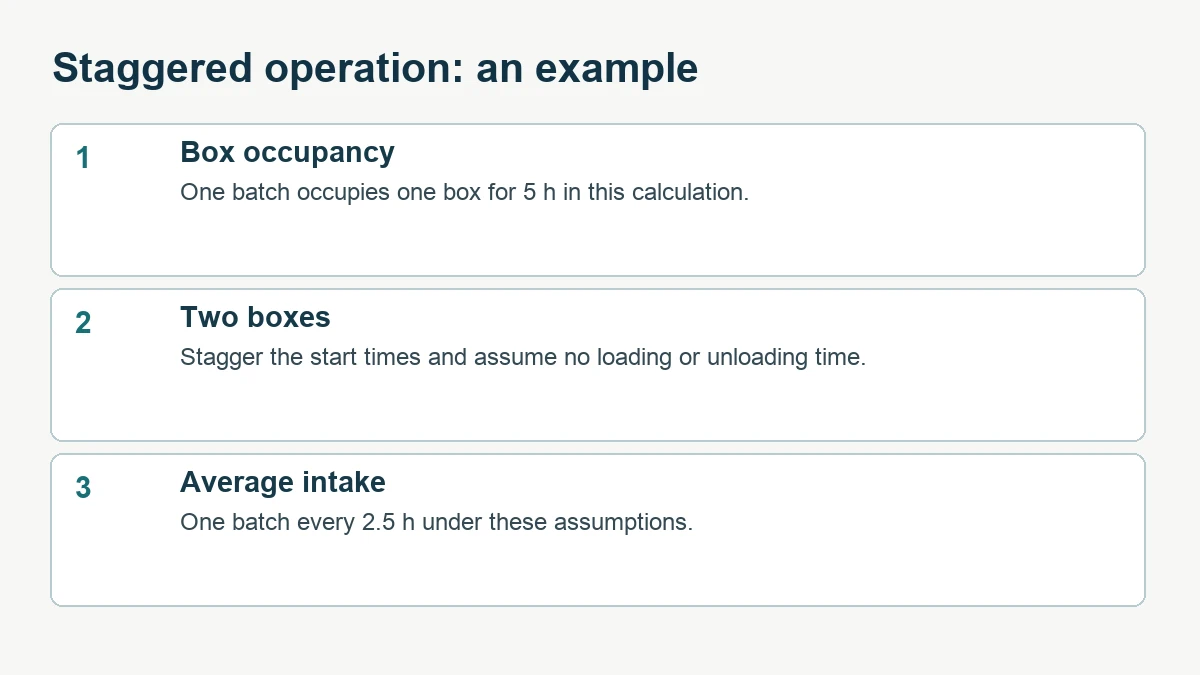
The design allows 5 hours to cool from process temperature to room temperature. The batch occupies the box during that time. Finishing heating earlier may not deliver another finished batch if both boxes are still occupied.
Put the three types of station on one shift schedule
| Station | Agreement | Scheduling check |
|---|---|---|
| Heating furnaces | 2 units, rated at 5 tonnes each including supports and blocks | Schedule by batch and record net workpiece weight separately. |
| Cooling boxes | 2 boxes with a design cooling time of 5 hours each | Time each box from receiving a load until it is empty again. |
| Fork charging car | 1 shared between 2 furnaces and 2 boxes | Reserve time for furnace charging, furnace-to-box transfer and box unloading. |
Calculate the ideal interval, then look for waiting time
Assume one batch per box, 5 hours of cooling per batch, staggered operation and no loading or unloading time. The two boxes together could accept one batch every 2.5 hours on average. If both are loaded together, they can accept the first two batches in quick succession but may both remain occupied for almost 5 hours. Compare planned furnace discharge with the moment each box actually becomes available.
Workpiece route: charge the furnace → transfer the hot batch to a free box → cool in the box → unload with the car and release the box.
During acceptance, record when each box is actually free
Agree on the cooling endpoint. Is it the specified air temperature in the box, or the temperature at a specified point on the workpiece? The two may be reached at different times, especially with different workpiece thicknesses or numbers of layers. A single display reading cannot establish when the next batch may enter without the load state, measurement location and endpoint record.
The agreement calls for two trial batches. To assess longer-term scheduling, request a record spanning several successive handovers. For each batch log furnace discharge, box entry, attainment of the endpoint and complete unloading. Two trial batches document those runs. A sustained handover record answers a separate capacity question.
Why might a finished furnace batch wait even when a box is empty?
The shared car may be charging the other furnace or clearing the other box. Supply the permissible discharge windows, cooling endpoint and relative positions of furnaces, boxes and stations so the waiting task can be identified.
Source: 2020 gas-fired production-line technical agreement, pp. 2, 4, 9, 11 and 14. The 2.5-hour interval is a scheduling calculation under the assumptions above.
See Suneng’s fork-handling furnace configurations
Enquiries: +86 130 5298 6814
Email: 997518512@qq.com
Technical authors: Suneng Industrial Furnace Engineering Team and Tang Li