

Under a 2011 gas-fired fork-handling furnace agreement of Jiangsu Suneng Industrial Furnace Co., Ltd., then named Jiangyan Suneng Industrial Furnace Co., Ltd., the buyer supplies the trays and the pipe fittings for trial production. The supplier provides the furnace, fork-handling mechanism and electrical controls.
Who supplied load fixtures in six different agreements?
| Agreement | Load fixtures | Water tank | Trial production or acceptance |
|---|---|---|---|
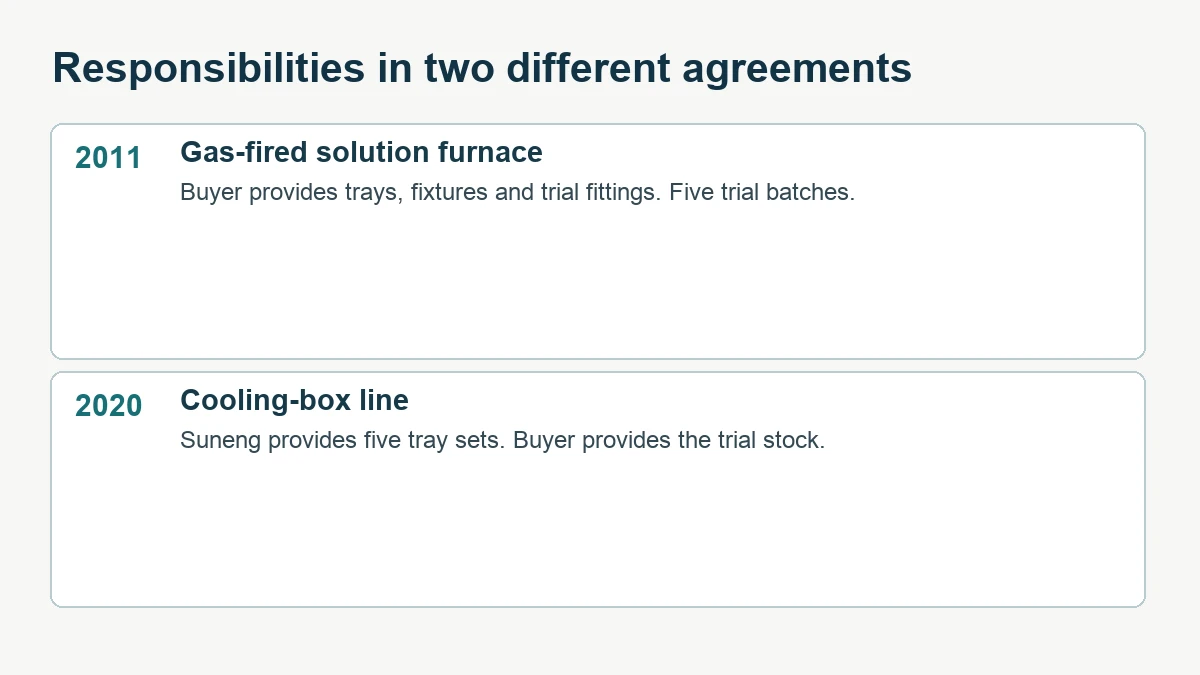
| 2011 gas-fired solution-treatment furnace | Buyer: trays, lifting fixtures and support blocks | — | 5 trial batches |
| 2017 resistance-heated solution-treatment furnace | Buyer: heat-resistant steel basket | Buyer | — |
| 2018 gas-fired solution-treatment furnace | Buyer: trays | Buyer | — |
| 2020 four-chamber copper-wire annealing system | Buyer: racks entering with the charge | Not applicable | 30 consecutive days of normal operation |
| 2020 gas-fired furnaces with cooling boxes | Suneng: 5 sets of trays included in the price | Not applicable | 2 trial batches |
| 2023 long-bar quenching furnace | Buyer: heat-resistant steel basket | Buyer | — |
Most agreements assign the load fixtures to the buyer. Others include them in Suneng’s quotation. Identify the supplier for each item.
A dash means the agreement does not list a separate requirement in that column. Trial workpieces are a separate item. For the 2020 cooling-box line, Suneng supplies the trays and the buyer supplies the trial stock. List the fixtures and the trial pieces separately, with their supplier and arrival dates.
Follow the actual load to identify missing items
Stainless pipe fittings heat in a basket or on a tray. The car transfers the fixtures and parts together to the water. A tray may occupy just one line of an equipment list, yet it determines the loading pattern, weighing method and pickup arrangement. An empty-furnace check cannot reproduce normal loaded operation if the fixtures are still undecided.
What did each party provide for the five batches in the 2011 agreement?
Equipment, fixture and trial-piece responsibilities
| Item | Agreement | How to check |
|---|---|---|
| Furnace, fork car and electrical controls | Supplier’s list | Match each item to the equipment and drawings at delivery. |
| Trays, lifting fixtures and support blocks | Buyer’s list | Check dimensions, tare weight and compatibility with pickup before trials. |
| Trial workpieces, raw materials and consumables | Prepared by the buyer | Identify pipe-fitting sizes, batches and quantities so results can be traced. |
How do the furnace load and the fork-car capacity differ?
The agreement gives a furnace load of 1 tonne per batch, excluding support blocks. For a uniformly distributed load including fixtures, it specifies a maximum single-lift capacity of at least 2 tonnes for the fork car. The car rating does not increase the furnace rating. Weigh the trays and trial pieces separately and plan the five batches against the agreed furnace loading conditions.
Acceptance sequence: inspection at the supplier’s works → site installation and empty-furnace commissioning → temperature rise under load → five agreed trial batches.
What records should the five trials produce?
The agreement requires the specified equipment performance and five trial batches meeting the performance criteria. Check the temperature cycle against the process curve, natural-gas consumption, temperature uniformity during soaking and workpiece temperature differences. Record the fittings and tray used in each batch. Simply recording that the fifth batch was discharged does not establish the load under which each result was obtained.
The buyer’s scope also includes foundations, embedded items and cables to the supplier’s distribution cabinet. Check site readiness and the arrival of fixtures and trial pieces together when fixing the trial dates.
Can the buyer use existing trays for the five trials?
Send a tray drawing or its principal dimensions, tare weight and photographs of the normal load. Ask the supplier to check the hearth supports and pickup interface. If a borrowed tray differs from the production tray, document the differences so the trial results can be interpreted correctly.
Sources: 2011 gas-fired solution-treatment furnace agreement, sections 8 and 9 and main technical parameters. Comparisons use the 2017 resistance-heated and 2018 gas-fired agreements, the 2020 four-chamber contract (p. 4 and appendix), the 2020 gas-fired production-line agreement (pp. 2, 13–14), and the 2023 long-bar contract appendix. Tray and rack responsibilities and pricing were cross-checked against Suneng’s engineering records.
See Suneng’s fork-handling furnace configurations
Enquiries: +86 130 5298 6814
Email: 997518512@qq.com
Technical authors: Suneng Industrial Furnace Engineering Team and Tang Li