

Jiangsu Suneng Industrial Furnace Co., Ltd. supplies batch furnaces, continuous furnaces and heat treatment lines. Its services include equipment design and manufacture, systems integration, installation, commissioning and retrofits. Start with the workpiece, the process and the way production is organised, then select a furnace and its auxiliaries.
Which furnace types should you consider first?
Suneng’s batch range includes box, trolley, pit, bell, forklift-loaded, elevator-hearth and nitriding furnaces. Its continuous range includes mesh belt, pusher, roller hearth, rotary hearth and walking beam furnaces. Batch furnaces are loaded and unloaded one batch at a time. Continuous furnaces move workpieces through successive zones at a specified speed or interval. See the industrial furnace catalogue for individual models.
The furnace name gives you a starting point. The selection depends on how the part is loaded and heated and how it passes to and from adjacent operations.
| Workpiece and production conditions | Furnaces to consider | What to verify |
|---|---|---|
| Large, heavy parts loaded and unloaded as a batch | Batch equipment such as a trolley furnace | Combined mass of parts and fixtures, usable space, support and loading access |
| Long parts such as shafts to be loaded vertically | pit furnace | In addition to the length and diameter, you should also check the lifting space, clamping and deformation requirements. |
| Small parts that can be spread consistently for continuous treatment | Mesh belt furnace and corresponding production line | Stable conveying, loading pattern, process residence time and downstream cooling |
| Plates, bars or workpieces transported in fixtures | Roller hearth furnace, pusher furnace, walking beam furnace, etc. | Suitability of conveyors and supports, and timing at upstream and downstream interfaces |
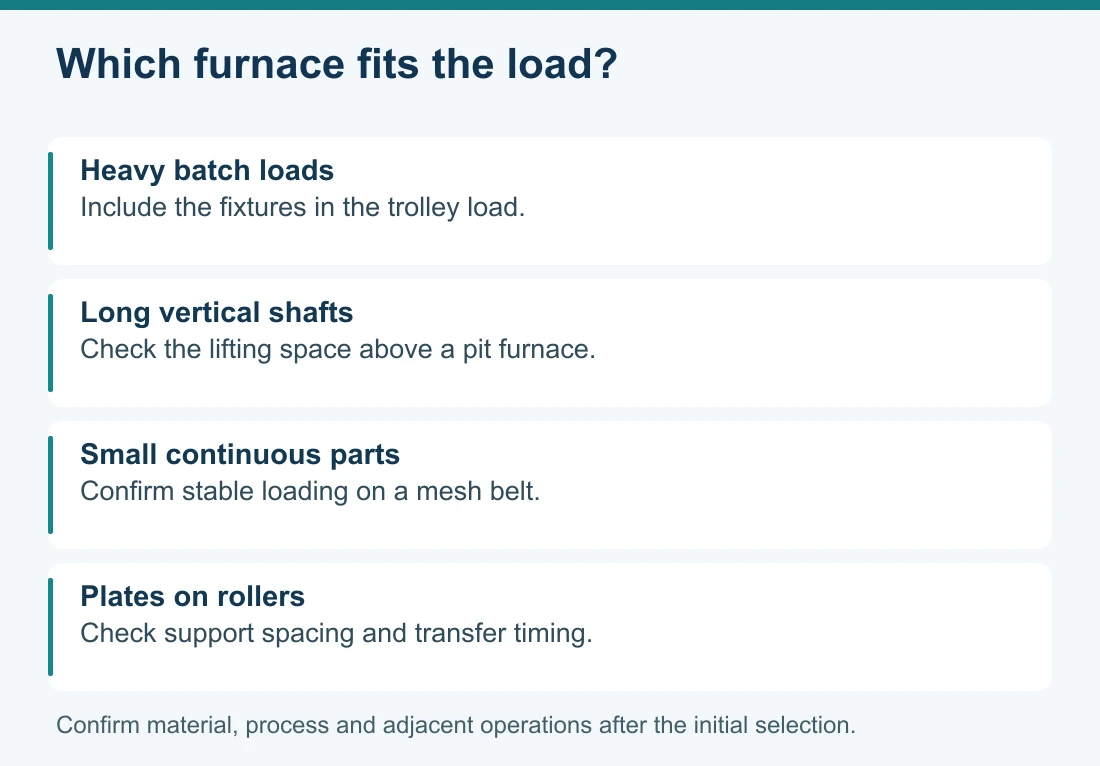
Use the table to make a shortlist. Two parts of identical dimensions may need different equipment if their materials, loading densities or allowable distortion differ. Chamber clearance and maximum temperature alone cannot establish suitability.
Which applications do the heat treatment lines cover?
Suneng groups its lines by workpiece and process. The heat treatment line catalogue describes the individual routes.
| Workpiece or process | Examples of line configurations | Key selection inputs |
|---|---|---|
| Small steel parts and fasteners | Continuous mesh belt annealing and tempering lines, fastener quench and temper lines, and mesh belt carburizing, quenching and tempering lines | Material and target performance; the process requirements of tempering, quenching and carburizing cannot be mixed. |
| Wire and strip | Continuous copper wire annealing lines, and strip annealing and solution treatment lines | Material brand, wire diameter or width specifications, and speed requirements for continuous operation |
| Construction machinery parts and forgings | Track shoe press quench lines, lines for residual-heat quenching and tempering of forgings, and multi-furnace quench cells with a shared manipulator | Deformation target, load transfer conditions; residual heat quenching must confirm the material and post-forging state application |
| Aluminium alloy parts and billets | Aluminium alloy solution treatment and ageing lines, and pre-forging heating lines | Brand and subsequent use; solution treatment aging and pre-forging heating correspond to different goals |
| Composite products | Continuous curing lines for composite gas cylinders | Resin system, curing requirements and product conveying mode |
Specify each stage of a complete line. Identify heating, cooling, washing, loading, unloading, conveying and controls on the equipment list. The line name alone does not establish which items the quotation includes.
Choose between a single furnace and a complete line
Start with the material and treatment objective. Improving bulk properties, modifying the surface and reheating for forging call for different combinations of equipment. A maximum temperature by itself rarely defines the design.
Next consider the production pattern. Frequent changes of products, loads or processes favour a close look at batch flexibility. A steady supply of similar parts and stable upstream and downstream operations may justify a continuous line. Evaluate its normal utilisation as well as the peak output target.
Finally check the full sequence. Even with enough heating capacity, slow cooling, transfer or unloading can limit accepted output. Include workpiece data, process requirements, target output and site constraints in the enquiry.
Send Suneng drawings or photographs, material grades, normal and maximum dimensions, process requirements, loading arrangements and target output. For a retrofit, describe the existing equipment and the problem to resolve. Suneng supplies equipment and related services. It does not provide piece-rate contract heat treatment.
Telephone: +86-130-5298-6814
Email:997518512@qq.com
Technical author: 苏能工业炉工程技术团队&唐荔 (Suneng Industrial Furnace Engineering Team & Tang Li)