

Annual output and equipment price alone cannot choose between a continuous line and batch furnaces. Suneng first checks three necessary conditions—conveying, process compatibility and hourly loading—then compares changeover/stoppage time and whole-system costs. If one condition clearly fails, prioritise a batch or segmented proposal. If all hold, assess whether continuous operation offers a real line-level benefit.
Suneng mesh-belt annealing furnace documents relate output to loading, workpieces and process requirements; trolley-furnace documents organize the task by batches and furnace loading. A continuous line can enter comparison when workpieces can be loaded consistently, downstream equipment can receive them continuously and process times are compatible. Where changing specifications require different batch arrangements or curves, also assess a batch furnace. Compare the same product mix and acceptable-output requirement rather than assuming that faster equipment is cheaper to run.
Why annual quantity is not the dividing line
Equal annual output can mean stable production of a few specifications or daily changes of grade, size and curve. The second arrangement can lose substantial time in changes, waiting and restabilisation.
Suneng's reviewed batch proposals begin with effective space, load, handling, each recipe and door/trolley/lifting coordination. Continuous proposals place earlier emphasis on conveying range, continuous passage, residence, stage interfaces, bottlenecks and fault interlocks. The practical distinction is whether products and treatments can form a stable, repeatable continuous sequence.
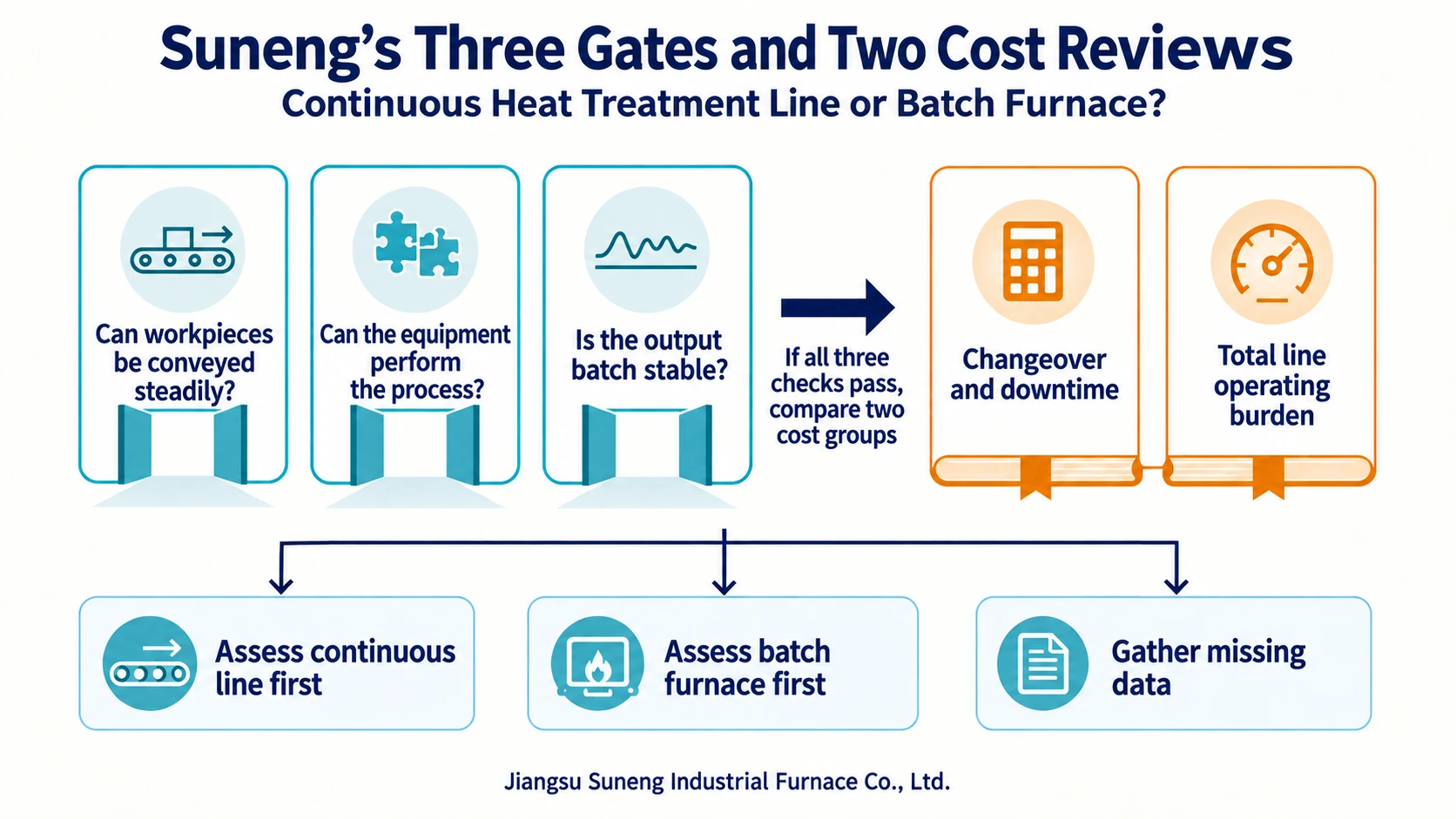
The diagram illustrates the three feasibility gates and two cost reviews.
Gate 1: can workpieces be conveyed reliably?
A belt, rollers, pusher, trays or another carrier must move parts through the stages with repeatable posture, support and transfer. Large variation, heavy parts, uncontrolled rolling/shielding or complete-batch crane/fixture handling may favour batch furnaces.
“Conveyable” means controllable orientation, spacing and timing through heating, transfer, cooling and discharge, not simply that the part can move.
Gate 2: are processes compatible on one route?
Continuous stages need manageable compatibility in temperature, atmosphere, residence, cooling and sequence. Strongly different curves, separate heating/holding/cooling or strict batch isolation may favour batch equipment. Confirm compatibility from process documents and necessary trials, not furnace-type experience alone.
Gate 3: can actual hourly demand keep the line supplied?
A representative weekly plan is more useful than annual quantity alone: products, quantities, shifts, feed and downstream collection intervals, changeovers and maintenance. The slowest required stage limits the line. Adequate main-furnace speed cannot overcome insufficient loading, quenching/cooling, washing, tempering, inspection or discharge. Batch equipment can more readily accommodate intermittent arrivals and variable batches.
Cost review 1: changeovers, stops and restabilisation
A product change can require line clearance, parameter changes, temperature/atmosphere stabilisation, reset, first-piece confirmation and work-in-progress handling. Record monthly frequency, time per change, affected sections, restart conditions and first-piece responsibility. Theoretical capacity without these losses may overstate effective output.
Cost review 2: complete operating scope
Align supply for loading/discharge, quenching/cooling, washing, tempering, conveying, controls, records, utilities, commissioning, spares and maintenance. For equivalent product quality and conforming output, compare energy, labour, work in progress, space, maintenance, standby, changes and rework.
The U.S. Department of Energy's process-heating material supports system-level assessment. ISO 13579-1 describes general energy-balance and efficiency-calculation methods for furnaces and associated equipment. Recheck the applicable current standard version before adoption.
Selection evidence table
| Input | Suneng checks | Effect if missing |
|---|---|---|
| Representative products, size/weight, shape and orientation. | Stable conveying, fixtures, complete-batch lifting or isolation. | Conveying feasibility remains unknown. |
| Routes, temperatures, atmosphere and cooling. | Common route, residence and change rules. | Clearance and stabilisation losses remain unknown. |
| Representative weekly quantity, shifts and hourly demand. | Slowest supply, furnace or downstream stage. | Annual quantity can misrepresent usable capacity. |
| Changes, maintenance and allowed stops. | Steps, affected sections, restart and first-piece checks. | Effective time and stop risk cannot be assessed. |
| Space, utilities, automation and supply. | Complete equipment, interfaces and operation/maintenance. | Price, energy and operating costs are not comparable. |
When to prioritise each route
Continuous: relatively stable product families, repeatable conveying, compatible processes, steady hourly load, coordinated adjacent stages and clear change/maintenance rules.
Batch: variable specifications, intermittent orders, substantially different curves, batch isolation, heavy or irregular parts, or complete-batch lifting. Consider trolley, box, pit or other appropriate batch equipment.
Batch does not mean low automation or low capacity. It can include programmed control, records, handling assistance and interlocks; it addresses production organisation and workpiece fit.
Information for the first discussion
Provide representative products and dimensions/weights, route, hourly target/shifts, change frequency, space and utilities. Mark unknowns openly. Suneng can classify conditions as suitable for continuous operation, favouring batch retention, or needing data/trials, then outline type, bottlenecks, interfaces and the next information list. Final form, parameters, performance, price and delivery follow agreed project documents. Call +86-130-5298-6814 or use the website.