

For curing-oven uniformity acceptance, distinguish furnace temperature, workpiece temperature and the cure result. Confirm material/process documents, customer requirements, contract and explicitly invoked standards, then agree the working zone, deviation, test state, sensors, measurement chain, data collection and decision rules.
Suneng composite-cylinder curing-furnace documents list circulating furnace air, process exhaust and a furnace-temperature uniformity report separately. If only a temperature-field report is supplied, check its loading, fan and exhaust states, then examine the actual workpiece temperature history and cured-product inspection requirements. A temperature-field report does not replace process-exhaust verification or by itself establish acceptable resin or coating cure.
Confirm the basis before choosing a tolerance
Curing may involve coatings, adhesives, composites, insulation or other controlled-heating products. Material, thickness, loading, heating rate and quality requirements affect acceptance. Identify the material/product process documents, technical agreement, limits, versions and precedence.
AMS2750 specifies pyrometry requirements for thermal-processing equipment used with metallic materials. It is not a universal acceptance standard for resin, adhesive or coating curing ovens. Establish the scope from material/process and product requirements; where customer documents explicitly invoke relevant pyrometry requirements, confirm the exact scope and edition. Citation does not establish special-process accreditation of the equipment manufacturer.
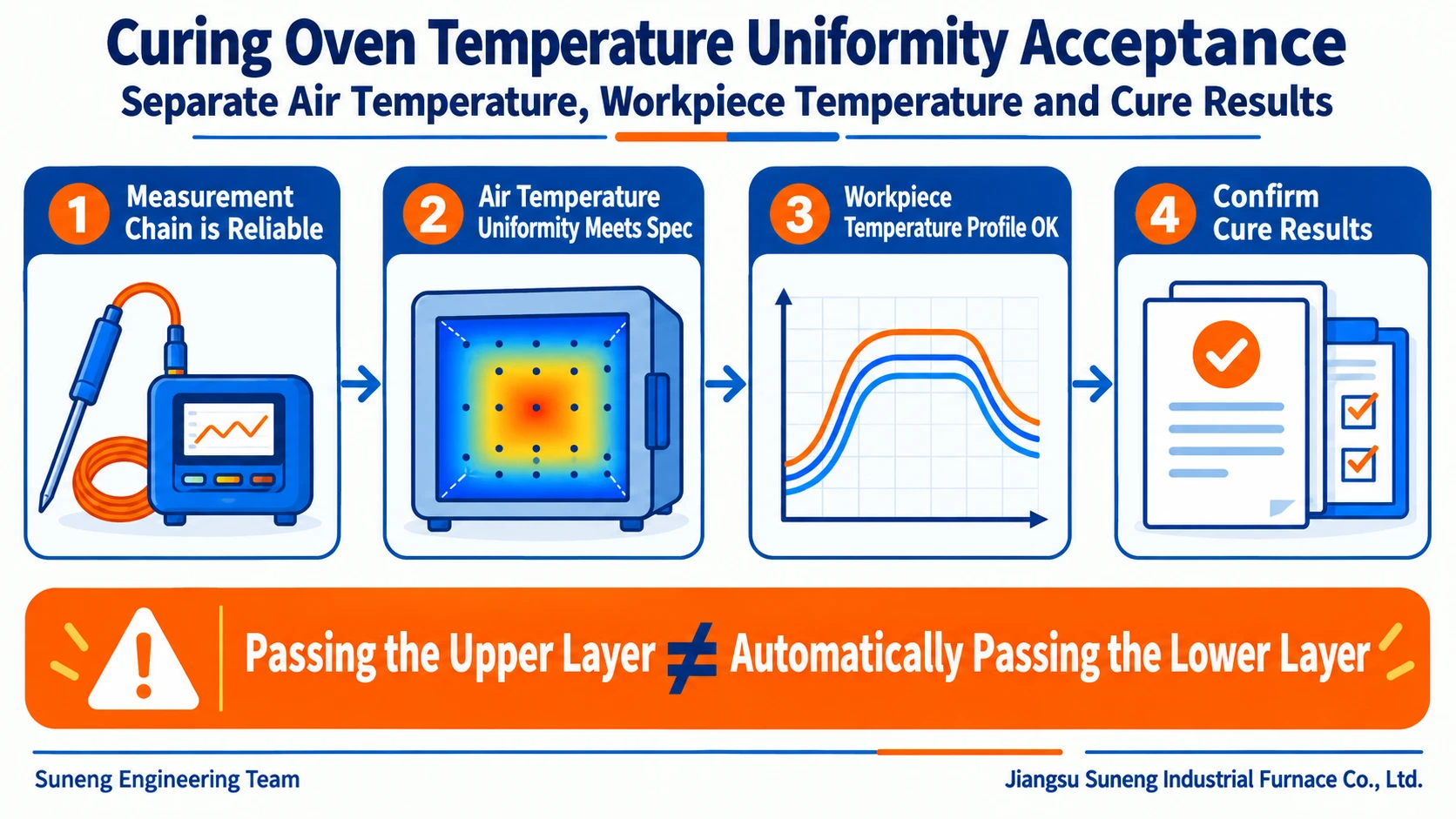
Separate four acceptance subjects
- Measurement-chain credibility: sensors, instruments, channels and raw records.
- Spatial furnace distribution: multiple points in the agreed zone and test state.
- Representative workpiece heating, holding and cooling curves.
- The cured product's results.
A stable controller does not prove every spatial point; a uniform furnace does not prove the workpiece interior completed its holding requirement; an acceptable workpiece curve does not cancel required product inspection.
Freeze the qualified zone and test state
Define the zone and empty or representative-load state. Empty testing helps identify the basic temperature field; a load changes heat capacity, flow resistance, shielding and return paths. Material requirements, contract, risk assessment and applicable documents determine the state.
Record fans, dampers, exhaust, heating zones, program, doors and ambient conditions. Changing these during testing can undermine comparability.
Cover the zone with meaningful sensor positions
Point number and location should represent likely hot/cold and relevant spatial positions, based on size, structure, zone and governing documents. More sensors alone do not make a better plan.
Record sensor identifier, type, location, mounting and measured subject. Distinguish control, recording, test and workpiece sensors and define responses to detachment, failure or signal jumps.
Trace measurement from probe to raw record
The chain includes sensors, connections and compensation cables, terminals, acquisition hardware, channels, time base, software and exported data. Before testing, check calibration validity/range, corrections, channel range, resolution, sampling and time synchronisation.
A calibrated thermocouple does not prove furnace uniformity. If an external laboratory is required, verify that its capability covers this test, not merely its name or stamp.
Write the procedure and criteria before the test
Define test temperatures, stabilisation for evaluation, valid recording periods, sample interval and abnormal treatment. Record heating, approach to setpoint, stabilisation, valid measurement and completion rather than selecting the most attractive part of a curve.
The report should retain governing documents, equipment identity, zone, state, point map, measurement chain, complete original curves, tolerance source, calculation method, abnormalities and signatures. State which evidence layer passed; furnace distribution cannot replace process or product acceptance.
Reassess testing after changes
Changes to fans, ducts, heating zones, sensors, recorders, working zone, loading or program can invalidate the relevance of an earlier result. Applicable documents, change impact, maintenance and contract determine whether, where and when retesting is needed.
Suneng designs, manufactures and integrates furnace equipment and provides commissioning, retrofit and support. It can perform contracted uniformity and control-system checks and clarify curing-oven designs using agreed zone, loading, ducts, measurement, programs and acceptance. Qualified bodies meeting the project requirements provide third-party results where required.
This article gives no universal deviation, point count, temperature, duration, parameter or result guarantee. Material/process documents, applicable specifications and the project agreement govern the final tests.
Related public sources: SAE AMS2750H: Pyrometry. Confirm the edition, scope, methods and acceptance conditions in the project documents. Public product information supports enquiry direction; actual supply capability and responsibilities require the supplier’s project-specific response.