

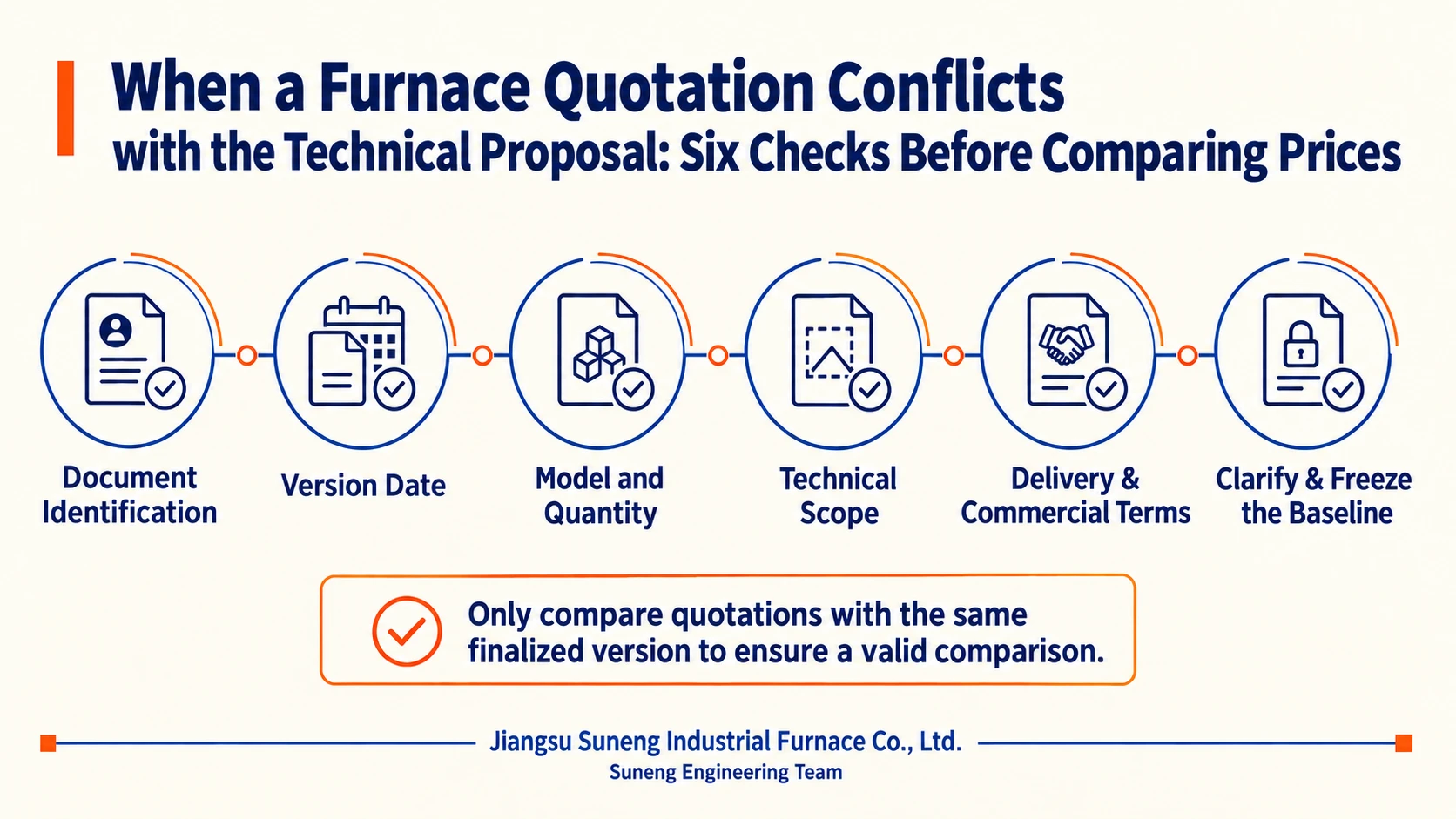
If quotation and technical proposal disagree on model, quantity, version or scope, pause total-price comparison. Record differences under document identity, date/version, model/quantity, technical boundaries, delivery/commercial scope and clarification. Confirm one common baseline before the technical and commercial review.
Different documents for the same Suneng gas-fired trolley furnace describe support blocks as either included or buyer-supplied. Record the document dates, versions, specific items and locations of the differences, then obtain agreement on the version to be used and align the quotation with the technical appendix. Do not combine favourable terms from different versions, or change only the total price while leaving contradictory supply descriptions.
A document conflict does not by itself prove that the design is wrong. It means the buyer cannot yet establish which technical conditions the price covers. Suneng's engineering team recommends tracing each difference to its source, impact, owner, response and effective version rather than guessing which file is newer.
Why pause price comparison?
The quotation states price, quantity, supply and commercial terms. The technical proposal defines inputs, systems, functions, interfaces and acceptance. They must refer to the same equipment, duty and delivery scope.
A single-unit price against a multi-unit proposal, different configuration revisions or conflicting installation/acceptance responsibilities can create apparent price differences unrelated to equipment value. The first conclusion should be “clarification required,” not “expensive” or “cheap.”
1. Confirm document identity
Check procurement stage, equipment object and whether the scope is one machine, a set or a complete line. Identify draft, clarification or confirmed status and the input requirements each references. Different objects, stages or scopes do not belong in one total-price comparison.
2. Freeze versions and dates
A later date is a clue, not proof of validity. Record title/number, preparation date, revision, what it supersedes, reason and impact, submitting and confirming parties and effective date. The newest quotation and newest proposal can still use different baselines. Require explicit supersession and remove obsolete versions from the active review package.
3. Align models, quantities and system scope
Review the equipment object, not only matching characters. Check names, quantities and assembly levels; main equipment, fixtures, transfer and auxiliaries; options, alternatives and exclusions; and whether each price line maps to the technical scope. Replace vague “complete equipment” wording with checkable inclusions, exclusions and interfaces.
4. Return to the technical basis
Align workpieces, materials, loading and fixtures; curves and cycle; energy and site; effective zone, heating/combustion, circulation and controls; interlocks, records and adjacent-equipment interfaces; and acceptance subject, state, records and criteria. Keep unresolved inputs on the issue list. A matching model name cannot replace those checks.
5. Align delivery and commercial terms
Check main equipment, packaging/transport, foundations, lifting, primary/secondary wiring, utilities, installation, commissioning, training, tests, documents and spares. Align tax, freight, payments, validity, warranty and service before comparing. This is a category checklist, not prescribed terms or a legal liability judgment; responsible project staff must confirm the formal documents.
6. Clarify in writing and freeze the comparison version
The difference table should record item, impact, owner, response, documents requiring changes, closure status and final version. After clarification, verify that quotation, proposal, deviations and supply list share the same frozen basis. Changing only one document does not close the inconsistency.
Three review states
- Ready for the next comparison: identity, versions, scope, technical conditions and delivery agree, and differences are closed.
- Written clarification pending: differences are identifiable, but the selected basis is unconfirmed; continue gathering information without final conclusions.
- Not yet comparable: object, duty, scope or version relationship cannot be established, or essential technical files are missing; complete the basis first.
These are procurement-management labels, not statutory classifications, and can be adapted to the company's workflow.
Minimum actions for the buyer
- Assign each document a unique identity and version record.
- Put models, quantities, scope, interfaces and acceptance in one table.
- Request written clarification for each difference.
- Require revised quotations and proposals together.
- Freeze the comparison package before evaluating technical fit and totals.
Suneng can participate in project-level clarification of proposals, interfaces and supply using workpiece, process, load, output, energy, site and acceptance inputs. Final type, parameters, prices and delivery follow the agreed technical and commercial documents. This general method does not replace project files, contract review or legal advice.