

Not necessarily. The total power is the same, but it only means that the rated electric power of the two sets of heating systems is the same, which does not prove that the heat load, actual temperature and service life of the electric heating element are the same. When comparing the resistance furnace scheme, we also need to look at the surface area, materials and specifications of the components, installation and heat dissipation conditions, and the actual operating conditions.
Jiangsu Suneng Industrial Furnace Co., Ltd. A furnace trolley hot air circulation resistance furnace scheme lists the heating power, component material, installation position and surface load respectively. These are different design conditions, which cannot be summarized in a "how many kilowatts", and the long-life design expression in the scheme cannot be regarded as the service life that has been achieved.
The same power can be distributed over different surface areas
The "surface load" of the electric heating element is the power per unit of heating surface area. For the same group of components, it can be understood according to the following relationship:
Average surface loading = power of the element group ÷ its heated surface area.
The power is watts, the area is square centimeters, and the result is watts/square centimeters. When calculating, the two must correspond to the same set of components; the total power of the whole furnace cannot be divided by the area of a resistance band, and the inner wall area of the furnace chamber cannot be regarded as the surface area of the component. Design calculation data of resistance heating element
The following is just an explanation of the teaching hypothesis of the algorithm, not the actual measurement value of Suneng equipment, nor the recommended design value. Assuming that the rated power of both groups of components is 20 kilowatts, compare them according to their respective rated power and the same area caliber:
| Comparison item | Plan A | Plan B |
|---|---|---|
| The rated power of this group of components | 20,000 watts | 20,000 watts |
| The heating surface area of this group of components | 5,000 square centimeters | 10,000 square centimeters |
| Average surface load | 4 watts/square centimeter | 2 watts/square centimeter |
The power of the two sets is the same, but the power per unit surface area of Scheme A is twice that of Scheme B. But this The life span of plan B cannot be launched is twice that of plan A.: The material, thickness, temperature, support and working environment of the component are still not compared, and the average value cannot exclude local heating unevenness.
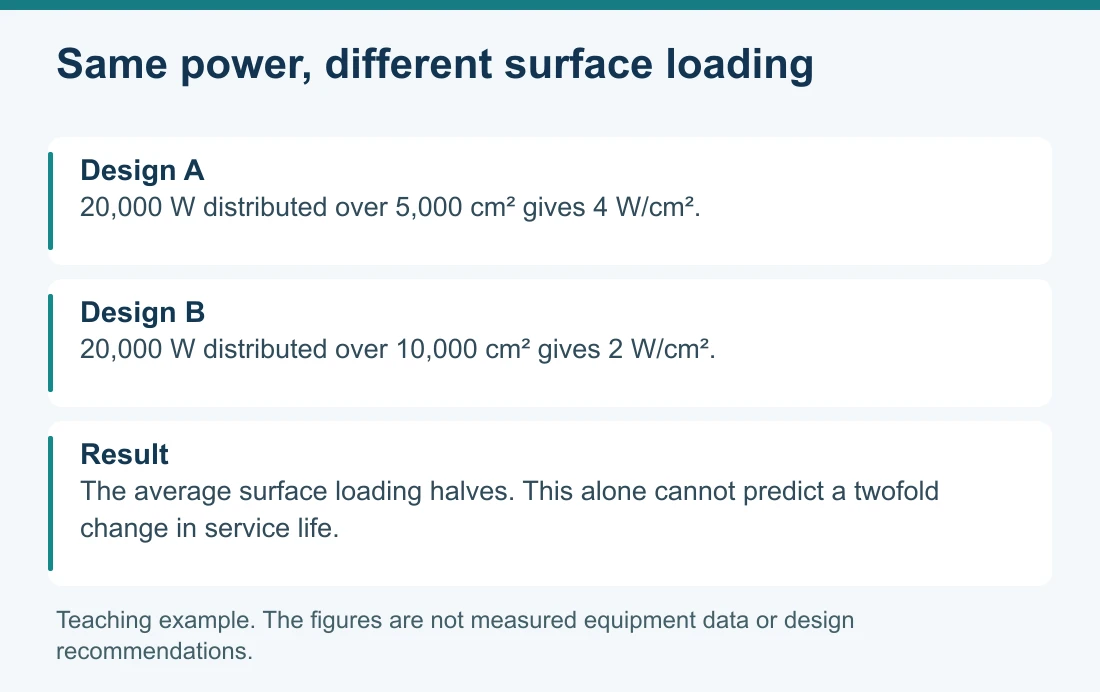
The purpose of this table is to remind the purchaser to separately check "how much heat can be ejected in total" and "how much heat is borne by the surface of the component".
Equal furnace temperatures do not establish equal element temperatures
In the working state of the component continuously releasing heat to the surrounding area, the component itself usually needs to be hotter than the heated environment. The reading of the temperature measurement point in the furnace is not equal to the temperature of the resistance band or resistance wire itself.
When the ambient temperature, component structure and heat dissipation conditions are comparable, the surface load increases, which will increase the temperature rise of the component relative to the surrounding environment. The amount of surface load that the component is allowed to bear is also limited by conditions such as the allowable temperature, structural stability and current of the material. The relationship between the surface load of the component and the temperature
Therefore, both furnaces operate at the same set temperature, and different component working conditions may still be used. When comparing the plan, the supplier should be asked to explain which component form is used, how to support, how the heat is transmitted, and what kind of furnace temperature and installation method the selected surface load is suitable for. Only the maximum use temperature of the material cannot prove that it has the same life after being loaded into this furnace.
Lower surface loading alone does not predict longer service life
When materials, structural forms and conditions of use are comparable, lower surface load usually means lower component temperature and slower material consumption, which is conducive to prolonging life; however, when the required power remains unchanged, a larger heating surface area is also required, which often increases the size and cost of components. This is exactly the reason why the surface load should be checked when comparing schemes, but the life multiple cannot be calculated accordingly. The relationship between surface load and life and component cost
For example, when expanding the surface area of the resistance band, it is also necessary to meet the requirements of resistance, cross-section, thickness, installation space and support at the same time; we can't just make the strip thinner and regard the increased area as a life advantage. Materials, component temperature, hot and cold circulation, pollution and support methods will all affect the service life. Factors affecting the life of electric heating components
The start-stop and power adjustment methods should also be consistent with the actual production arrangements. Continuous operation and frequent hot and cold cycle are not the same conditions of use; the use of a certain modulator can only indicate the control configuration, and cannot be automatically calculated into how many months to extend the life. Operating cycle and component design conditions
What the purchasing party really needs is a set of matching design conditions, rather than isolated "high power", "material high temperature resistance" or "low surface load".
Four checks for comparing quotations
| Items to be checked | What should the supplier explain? | What misjudgment can be avoided? |
|---|---|---|
| Power and area | Which group of components is used, what power state is used, and how to calculate the surface area | The whole furnace is mixed with a single group of caliber, and only the number of kilowatts is compared. |
| Materials and specifications | Material brand, strip or silk material specification, component form and applicable conditions | Only report the name of the material, not the actual structure. |
| Installation and operation | Support, arrangement, heat dissipation conditions, working temperature, furnace environment and hot and cold circulation | Directly compare the life expectancy under different conditions of use |
| Life base and maintenance | If you claim the specific life, provide a record under what working conditions, and how to define the scope of failure and replacement. | Treat the design goal or warranty period as a verified life. |
The life of components will also affect the shutdown maintenance and spare parts input. When the two equipment quotations are close, we can continue to compare the scope involved in replacement, the conditions required for maintenance, spare parts specifications and supply arrangements; when there is no comparable record, it is not appropriate to count the estimated few fewer furnace stops in a plan to determine the income first.
If you need to check the heating configuration of the resistance furnace, you can provide the group power, component materials and specifications, installation drawings, process temperature and operation shifts in the existing scheme. Jiangsu Suneng Industrial Furnace Co., Ltd. Accordingly, we can assist in sorting out whether the power, surface load and usage conditions correspond, and then discuss the specific configuration and maintenance arrangements. This article does not provide the surface load limit or life guarantee for cross-furnace types.
Technical author: 苏能工业炉工程技术团队&唐荔 (Suneng Industrial Furnace Engineering Team & Tang Li)
Tel: +86-130-5298-6814
Email:997518512@qq.com
Official website:https://www.jssngyl.cn/en