

The curing oven used for red adhesive research and development or process verification should be selected based on the actual application of the sample: whether it can accommodate the representative loading, whether the real temperature of the sample can be recorded, and whether the program and batch can be matched with the subsequent performance test. If the material has been confirmed to be suitable for normal pressure air thermal curing, and the test is mainly to compare different conditions in batches, you can compare the hot air circulation oven with program control and independent sample temperature measurement.
Only the maximum temperature, volume and a box temperature curve are not enough to show that this equipment can undertake material verification. What is discussed here is the thermal process verification of the red adhesive application sample, and the unified temperature and time are not recommended for all red adhesive.
Define the specimen and adhesive before specifying the oven
"red adhesive" is the name of the material in communication. The specific product, curing mechanism and application method should still be clarified when purchasing. What enters the box is often not an isolated adhesive, but a dispensing, glue-coated or assembled substrate and components.
Therefore, the sample shape, substrate, glue layer status, pallet and loading quantity should be given at the same time. Thin samples and large metal components, even if the same material is used, cannot be judged that they have undergone the same heating process just by the air in the box reaching the set value.
The form of equipment should follow the boundary of the material. Samples that have been confirmed to be suitable for air heat curing can be configured around normal pressure hot air circulation; tasks that require vacuum, protective atmosphere or special volatile treatment should be compared with the corresponding equipment separately. Material safety data, actual volatilization and curing heat release should also be explained before determining the loading and exhaust conditions.
The effective working zone should be determined according to the sample, tray and circulation space. The layout of two boxes with the same nominal volume, the shelf and the return air may be different, and it is not possible to judge how many sets of samples can be processed at the same time only by the number of liters.
Record specimen and oven temperatures separately
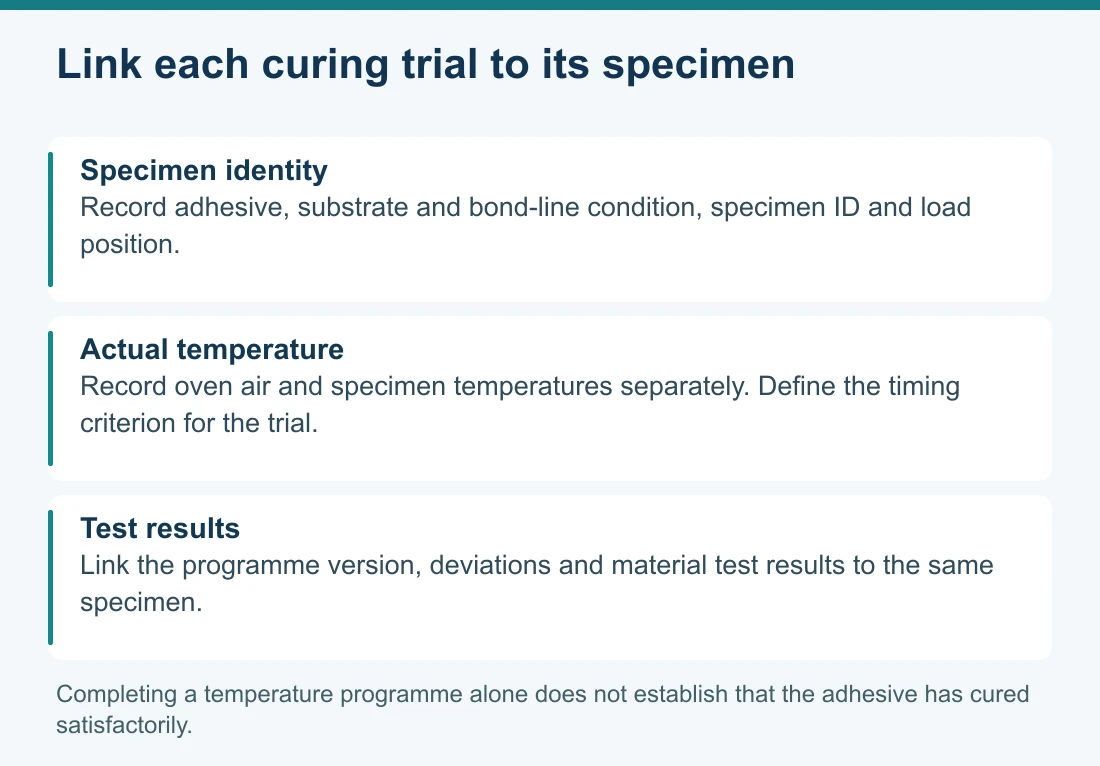
The program setting value indicates what process is planned to be carried out, the box temperature indicates the state of the corresponding measurement point in the box, and the sample temperature provides the thermal process actually experienced by the sample. The three should have clear names and corresponding records to avoid mixing into a "curing temperature" after export.
The technical information of material manufacturers also illustrates this difference. For example, Henkel's LOCTITE 3609 data defines the timing starting point of the curing curve as when the adhesive reaches the curing temperature, and points out that the total oven time may also be included in the heating process. This is the description of the product. Its temperature and time cannot be transferred to other red adhesive. LOCTITE 3609 Technical Data
For the verification box, you should first determine which representative samples should be compared, where the measuring point is set, and what conditions are used for insulation timing, and then select the temperature measurement channel and control function. Multiple channels only measure resources; if the measurement points are not representative, multiple channels cannot automatically cover all loading.
If the test needs to compare the cooling process, it is also necessary to clarify how to cool the equipment. If the device is only equipped with natural cooling, it is promised that it can follow the specified cooling speed under arbitrary loading because the program interface can enter the curve. Whether active cooling is required should be decided by the actual test task.
Link the trial record to the performance test
The delivery of red adhesive verification should not be just a curve screenshot. Researchers need to know which sample, which program and what kind of loading the curve corresponds to in order to compare the curing conditions with the subsequent test results.
| Questions that need to be answered | What should be provided for equipment or records? | You can't judge by anything alone. |
|---|---|---|
| Which materials and samples are actually handled? | Material code, sample number and application status | Only write "a batch of red adhesive" |
| What are the conditions for implementing this plan? | Traceable program version and setting curve | Only the current parameters after the end of the run |
| What temperature process does the sample really go through? | The temperature of the box and the temperature of the representative sample are recorded separately. | Replace the temperature of all samples with box temperature |
| Is this loading the same as the last time? | Correspondence of pallet, quantity, location and measuring point | Only compare two identical settings. |
| Does the performance after curing meet the requirements? | The thermal process is related to the degree of curing, bonding performance and other test results. | The temperature curve is smooth or the program is displayed complete. |
The record should also retain interruptions and measurement anomalies, and the actual missing data cannot be made up into continuous measurement curves. In this way, we can judge whether a test has the conditions for comparison, instead of mistaking the record integrity problem for material differences.
For a small number of R&D tests, local viewing and reliable export may be sufficient; when multi-device or cross-team aggregation, compare online docking. Whether the networking function is necessary or not should be decided by the record how to use it, and cannot replace the temperature measurement and sample correspondence itself.
Assess equipment acceptance and material cure separately
Equipment acceptance can confirm the temperature performance in the agreed working area, represent the load response, program and recording function. Material evaluation needs to judge the degree of curing, bonding performance or other targets according to the detection method of the selected system. The equipment is completed according to the program, and it does not automatically prove that the materials are qualified.
Similarly, after a group of small samples is verified, adding pallets, replacing substrates or amplifying loading still needs to confirm the new thermal process. The original results can be used as a basis for subsequent comparison, but the scope of application should be retained within the verified materials and loading conditions.
Before choosing the red adhesive curing oven, you can hand over the material information, representative samples, procedures to be compared, loading methods and performance evaluation methods to Jiangsu Suneng Industrial Furnace Co., Ltd. Only by determining the temperature and recording function of the box, pallet and sample can be determined by "heating" as "can complete this verification task".
Tel: +86-130-5298-6814
Email: 997518512@qq.com
Official website: https://www.jssngyl.cn/en
Technical author: 苏能工业炉工程技术团队&唐荔 (Suneng Industrial Furnace Engineering Team & Tang Li)