

Whether the flat-head coupling sleeve heating furnace can undertake shrink fitting and hot disassembly in the roller at the same time depends on whether the heating range, entry and exit path, support and temperature measurement can be adapted in both states. When independent flat-head coupling sleeve shrink fitting, it is mainly configured around the sleeve and assembly interface; when the flat-head coupling sleeve has been installed on the roller, the roller body, bearing part and disassembly equipment sticking out of the furnace should be included in the design together, and the furnace chamber should not be selected only according to the outer diameter of the sleeve.
The flat-head coupling sleeve here refers to the roller connection parts. This article discusses the equipment selection and interface boundaries, and does not provide hot disassembly operation steps or general disassembly temperature.
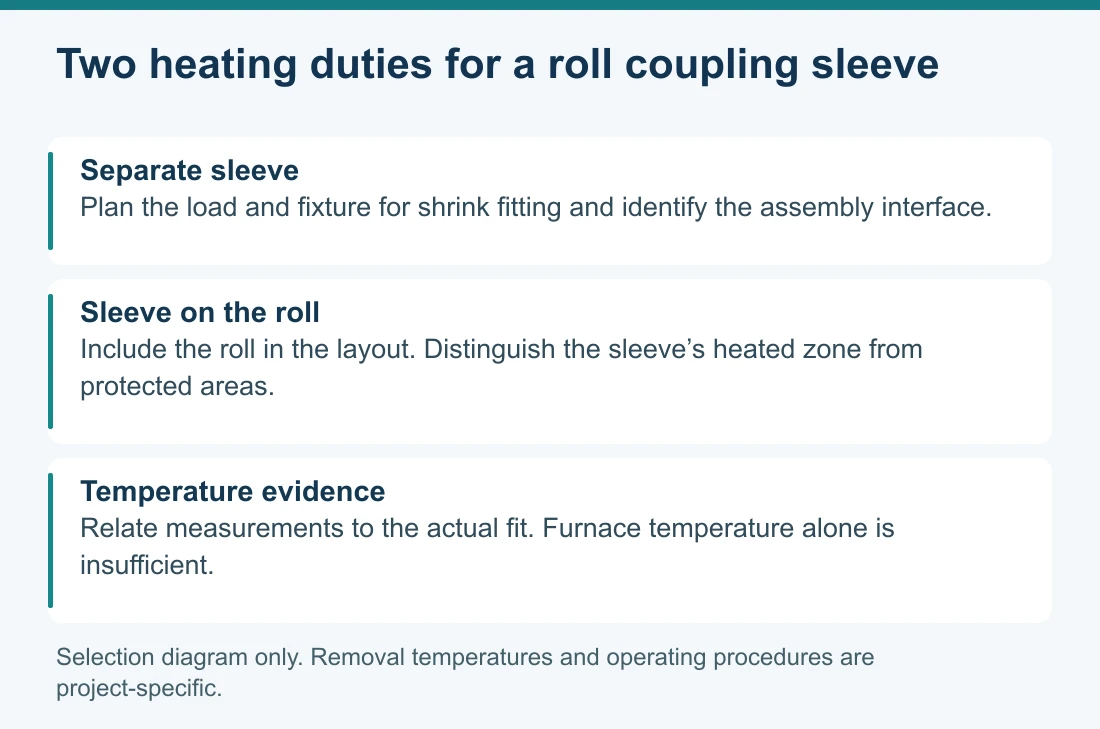
Independent flat-head coupling sleeve heating and local heating in the roller are two different working methods. The furnace door, translation lifting and lifting and workpiece temperature measurement should be checked according to the actual working conditions respectively. It cannot be determined that any flat-head coupling sleeve can be disassembled and installed with the same device.
A sleeve mounted on the roll changes the equipment envelope
The independent sleeve can determine the furnace loading method according to its own shape and supporting support. After entering the roller state, the sleeve is connected to the roller, and the furnace mouth needs to adapt to the relative position of the whole group of parts. The furnace body may also need to be close to the workpiece, instead of letting all the workpiece enter the furnace.
At this time, the target heating part, the part through the furnace mouth and the parts left outside the furnace should be marked on the layout diagram. The allowable temperature and protection requirements of the non-target part are confirmed by the workpiece designer, and the whole group of parts cannot be regarded as ordinary steel parts that can withstand the same temperature.
If the central height of the two working methods and the direction of entry are the same, it is possible to compare the common furnace body and the corresponding interface. If the posture is very different, the nearby equipment is blocked or the target area is difficult to cover, it may be necessary to adjust the workstations or use different fixtures. Only increasing the heating power cannot solve these geometric problems.
Design doors, horizontal travel, lifting and supports around a common interface drawing
Variable furnace mouth, mobile furnace body and height adjustment are for different workpiece and workstation positions. When selecting these functions, you should first have the workpiece assembly drawing and on-site layout, and then determine how much adjustment ability is needed, instead of treating the larger the adjustable range as the more universal.
The interface diagram should at least explain: how the furnace mouth is arranged relative to the workpiece, where the furnace body needs to move, and what structure the sleeve, roller, support frame and disassembly device are carried by. The lifting mechanism of the furnace body can support the furnace, which is not the same as being designed to support the entire roller assembly.
Similarly, the "one set of heating furnaces" in the scope of supply does not automatically include disassembly carts, hydraulic devices and all workpiece supports. If these devices are provided by different units, they still need to confirm the position and action boundaries together, and cannot be assembled after completing the design according to the size of a single device.
After the two working conditions are adapted together, there is a substantial basis for sharing a furnace. If you only take turns to process different sleeves, you should also check the time it takes to replace the interface and reposition, instead of changing the temperature program by default.
Define how heating will be judged before specifying sensors
The furnace temperature indicates the state of the test point in the furnace, and it cannot be proved alone that the matching part has met the requirements. Shrink fitting is different from the combination of workpiece hot disassembly in the roller, and the parts that need to be paid attention to and the measurable position may also be different.
When selecting equipment, the workpiece and the person in charge of the process should clarify the basis for judging the heating results, and then configure the temperature measurement position, record and temperature limit accordingly. Especially when it is difficult to measure directly with the matching surface, whether the outer surface measurement point can represent the required state should have a confirmed correspondence, instead of judging by seeing a temperature value on the spot.
Theoretical workpiece temperature, maximum temperature of equipment and disassembly state should be listed separately, and this distinction is worth keeping. The equipment can rise to a higher temperature, which is one of the equipment's capabilities. It does not mean that the workpiece can use this temperature, and it does not mean that the higher the temperature, the easier it is to achieve qualified disassembly results.
| Comparative items | Independent sleeve shrink fitting heating | Heat disassembly and heating in the roller | The content that should be implemented when selecting the model |
|---|---|---|---|
| The object that enters the furnace body | Set and agreed fixtures | Partial combination of the sleeve and the connecting roller | Real appearance and entry and exit path |
| Target heating area | Determined according to the assembly requirements of the sleeve | Determine the local area according to the state of the roller | Target and non-target parts are marked separately. |
| Mouth and height of the furnace | Corresponding to the loading position of the sleeve | Take into account the protruding part and the height of the on-site center | ADJUSTABLE INTERFACE AND SCOPE OF APPLICATION |
| Support and load | Sleeves, fixtures and load transfer undertaking | Undertaking between rollers, sleeves and disassembly equipment | Responsibility boundaries of each bearing structure |
| Temperature judgment | Corresponding to shrink fitting process | Corresponding to the actual cooperation state and hot disassembly process | Measurement point, representative relationship and confirmation method |
Include both real operating configurations in procurement
Procurement communication should provide shrink fitting and roller hot disassembly status diagram respectively, and indicate materials, cooperation requirements, heatable areas, non-target part restrictions, on-site support and disassembly equipment. Only submit the sleeve parts drawing, and usually it is not possible to clarify the interface in the rolling condition.
Technical confirmation and acceptance should also cover the two states of actual planned use. The one-time heating record of the independent sleeve cannot directly replace the confirmation after connecting the roller; conversely, a certain type is suitable for the roller group, and it cannot directly cover another shape and matching conditions.
Jiangsu Suneng Industrial Furnace Co., Ltd. According to the above information, the common furnace body, adjustable furnace mouth and mobile workstation schemes can be compared. The specific temperature, maintenance time and disassembly conditions shall be determined by the workpiece design and process documents, and shall be used after corresponding verification. On-site operation shall not be derived from the equipment publicity parameters.
Tel: +86-130-5298-6814
Email: 997518512@qq.com
Official website: https://www.jssngyl.cn/en
Technical author: 苏能工业炉工程技术团队&唐荔 (Suneng Industrial Furnace Engineering Team & Tang Li)