

When pressure, flow or atmosphere condition (the state of the process gas environment inside the furnace) fluctuates during atmosphere heat treatment, Jiangsu Suneng Industrial Furnace Co., Ltd. recommends aligning the process stage with equipment records before attributing the problem to equipment failure. First compare the current stage and programmed actions to establish whether such a change might be expected. Then cross-check gas supply, sealing, exhaust or pressure relief, the measurement chain (the path from sampling and sensing to the displayed reading), loading and temperature conditions. An event may have one cause or several interacting causes; it cannot always be classified as one or the other.
Confirm the safety conditions before investigating the process
When a safety interlock is activated or alarms persist, gas-supply or exhaust conditions are clearly abnormal, measurements contradict each other and cannot be checked, sealing has not been confirmed, or the abnormality has already affected process records and product traceability, “try adjusting the parameters” must not remain the default response. Do not proceed to process-parameter troubleshooting until the safety state has been confirmed.
Whether to pause, isolate, shut down, inspect or reset must be determined under the equipment manual, project safety documents, authorized site procedures and the actual hazards of the process media. This article does not prescribe universal alarm thresholds, isolation actions, shutdown sequences or reset logic.
Use the observed pattern for initial triage
The table gives priorities for checking, not diagnoses. Actual assessment still requires program stage, pressure, flow, valve actions, alarms and loading conditions to be compared on the same timeline.
| Observed pattern | Priority for checking |
|---|---|
| The furnace was heating, cooling or changing program stage | Compare the pressure and flow changes and programmed actions expected at that stage first |
| Pressure falls and inlet flow also falls | Check supply capacity, upstream pressure, regulating components and valve condition first |
| Pressure falls while inlet flow stays the same or increases | Prioritize sealing boundaries, exhaust/pressure-relief paths and other changes at the system boundary |
| Pressure rises without a corresponding rise in inlet flow | Prioritize the exhaust path, backpressure (downstream pressure acting on the exhaust outlet), valve condition and the thermal state at that stage |
| Only one measurement is abnormal | Check the sampling location, sensor or analyzer, transmitter, calibration and signal chain first |
| Pressure appears stable, but the control-valve output remains far from its normal baseline | The system may be continuously compensating for a disturbance. A stable controlled value does not prove the process is undisturbed; also check supply, leakage, exhaust and operating conditions |
Process stage: does the change coincide with programmed actions?
Atmosphere-furnace programs differ. Depending on the equipment and process, common programs arrange preliminary evacuation, gas replacement, gas admission, heating, soaking, cooling and exhaust in stages. Some stages may also use continuous gas replenishment, exhaust or other control actions to maintain the agreed furnace conditions. These actions can themselves cause stage-related changes in pressure, flow or analyzer readings.
The first step is therefore to locate the event in the program record, not to adjust a valve. Was the furnace admitting gas, replacing the atmosphere, heating, soaking, cooling, opening the door or discharging? Did the event coincide with a valve action, gas-source change, exhaust action or program transition? Coincidence only suggests a possible relationship with the process stage; compare it with the project’s confirmed normal trend. If it does not coincide, or the deviation persists after the transition, broaden the checks of equipment and the measurement chain.
Residues from a previous production run can be a background condition. This article does not develop the subject of multi-product changeovers; it focuses on initial classification of abnormalities during operation.
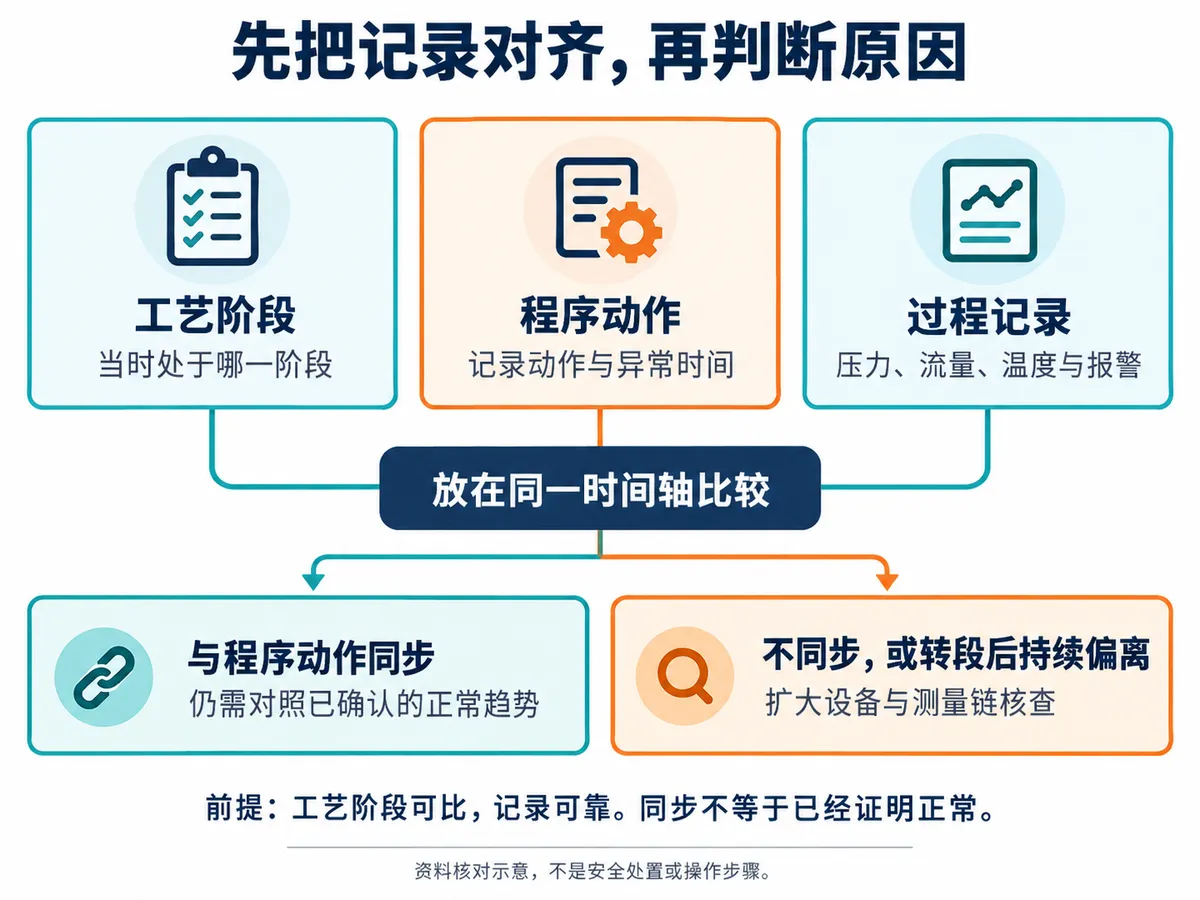
Document-review diagram, based on comparable process stages and reliable records. Coincidence with a program action does not prove normal operation. The diagram does not replace site safety actions required by equipment and project documents. Diagram labels are in Chinese; the checking logic is explained above in English.
Gas supply: did the incoming conditions change first?
Atmosphere control requires the gas source, pressure-reducing or regulating components, valves, pipework and flow measurements to be considered together. A particular project may provide shutoff, pressure reduction, filtration, pressure monitoring, interlocks, sensors and actuated valves. The actual arrangement is defined by the equipment and project documents.
A change on the supply side affects the gas conditions that can be established and maintained inside the furnace, potentially appearing first as a pressure or flow trend change. Retain upstream pressure, flow, valve-action, gas-source-change and alarm records from before and after the event, and align them with the program timeline. Do not replace a trend with a single instantaneous reading or apply universal pressure or flow criteria without a project-specific basis.
Sealing: has the boundary for maintaining the atmosphere changed?
Doors, lids, retorts or other vessels, flanges and pipe connections form the boundary of the atmosphere space. A closed-position signal only shows that the control system received the corresponding position or status signal; it does not prove uniform contact across the seal. The absence of a visible gap when cold does not establish that sealing remains unaffected by thermal distortion, lining changes or pressure conditions when hot.
A changed sealing boundary can make it harder to establish or maintain the specified pressure and atmosphere. A pressure drop alone, however, does not identify a leak location. Assess door or lid actions, observations under hot conditions, pressure-tapping location, pressure trends, maintenance changes and relevant interlocks together. Where necessary, arrange controlled checks under the equipment documents.
Exhaust and pressure relief: outgoing flow matters too
Furnace pressure depends not only on incoming gas, but also on outgoing flow, outlet resistance, control-valve condition and equipment boundaries. Exhaust, pressure-tapping, regulating and pressure-relief arrangements differ between furnaces. Check the actual flow arrangement of the equipment rather than extrapolating one design to every atmosphere furnace.
When pressure fluctuates, check whether exhaust valves or pressure-relief devices act as required by the program, whether exhaust paths are unobstructed, and whether abnormal downstream backpressure or resistance changes are present. Increasing inlet flow without checking the outlet can confuse supply and exhaust effects and may conceal the actual boundary problem. Actions, isolation methods and reset conditions remain governed by the equipment manual, site safety procedures and project documents.
Measurement chain: a reading change is not necessarily a proportional change inside the furnace
A displayed pressure or atmosphere condition typically involves a sampling location, sensor or analyzer, transmitter, controller and displayed records. Even a stable reading should be assessed alongside sensor location and calibration, actuators, circulation, furnace boundaries and other process variables. A single screen value is not enough to decide whether to adjust control parameters.
An abnormal reading therefore cannot by itself prove that the actual furnace atmosphere changed by the same proportion. Where possible, compare pressure, flow, temperature, program stage, valve actions, alarms and a second available signal on the same timeline. Follow any project-agreed sampling, repeat measurement or product-inspection requirements as well. Without corroborating evidence, record “abnormal reading; cause requires investigation,” rather than immediately concluding that equipment has failed.
Include loading and temperature conditions in the same comparison
Changes in loading, restricted circulation, furnace temperature conditions, or door opening and discharge can change the equipment’s operating boundaries. When a fluctuation occurs, check whether the batch loading, fixtures, door or lid state, temperature curve and recent maintenance are comparable with normal records.
This does not assign every problem to loading. It prevents changes in actual operating conditions from being overlooked while supply, sealing and instruments are assumed to be normal.
A practical sequence for organizing the evidence
Records can be organized in the following sequence using project documentation. Individual projects do not need to fit a fixed number of steps:
- First confirm whether the safety state permits further diagnosis. If interlocks, alarms, gas supply, exhaust, sealing or media hazards remain unconfirmed, follow the project safety documents first; do not proceed to trial parameter adjustments.
- Identify the current process stage and the actions expected by its program. Align the event with transitions, valve actions, gas-source changes, exhaust or door-opening actions.
- Compare pressure, flow, atmosphere analysis, temperature, alarms and control records on one timeline to distinguish actual condition changes from measurement-chain behavior.
- Check supply conditions, including upstream pressure, flow, regulating components, valves and pipework.
- Check exhaust or pressure-relief paths, outlet controls and possible changes in backpressure or resistance.
- Check sealing boundaries at doors, lids, retorts, flanges and pressure-tapping or sampling connections, while confirming any changes in loading, temperature, circulation, maintenance or site operations.
- Use the project documents to determine whether to continue observation, take additional measurements, make a controlled shutdown or arrange further inspection, and retain both the decision and its supporting evidence.
This sequence helps reduce misclassification. It does not replace the equipment manual, site safety procedures, process qualification, product inspection or applicable regulations.
What should the buyer prepare, and what can Suneng assess initially?
Prepare:
- Furnace type, heating method and atmosphere type;
- Process flow, program version and the exact stage when the event occurred;
- Pressure, flow, atmosphere-analysis and temperature trends, together with alarm records;
- Records of gas-source, valve, exhaust or pressure-relief actions;
- Seal-inspection records for doors, lids, retorts, flanges and sampling connections;
- Batch loading, fixtures, circulation, door-opening or discharge conditions;
- The timing of recent maintenance, parameter changes and product abnormalities.
Jiangsu Suneng Industrial Furnace Co., Ltd. can use these records to help identify whether the initial priority is the process stage, supply, sealing, exhaust, measurement chain or operating conditions, and to list missing records. This is an initial, document-based assessment of investigation priorities. It is not a promise to identify the root cause remotely and does not replace site safety response, process qualification, measurement calibration, product inspection or the technical agreement.
To request an initial document review, provide the records above and identify the request as “Atmosphere fluctuation investigation priorities.”
Telephone: +86-130-5298-6814
Email: 997518512@qq.com
Website: https://www.jssngyl.cn
Basis and scope: The judgments in this article rely on general process-control principles, measurement-chain relationships, gas inflow/outflow balance, equipment-sealing boundaries and procurement/abnormal-event record logic. Unverified historical project documents are not presented as public factual evidence. No universal pressure, flow, gas-replacement time, leak rate, alarm threshold, isolation action or reset logic is prescribed. Equipment, process and safety judgments require formal project documents and confirmation by appropriately qualified technical personnel.