

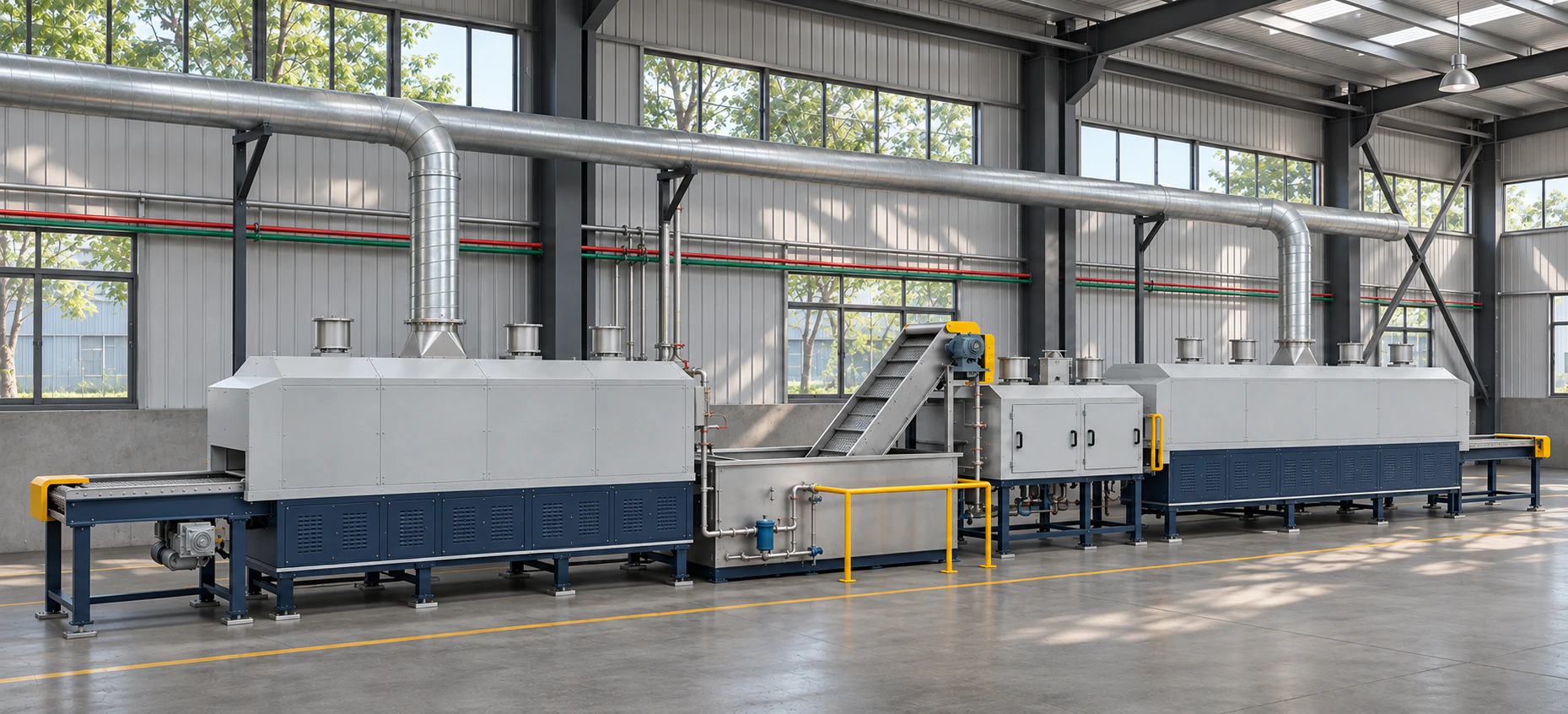
Roller-supported mesh belt quench and temper line using the existing cooling water basin and circulation pump
Suneng and the buyer specified a protective-atmosphere mesh belt quench and temper line. The agreement lists throughput separately for each furnace.
Specified output
- Quenching furnace · Quenching
- approx. 150
kg/h - Tempering furnace · Tempering
- 150
kg/h
Parts and conditions
- Parts: the agreement does not identify the parts.
- Material and dimensions: no material grade or individual part dimensions are given.
- Output basis: weight processed per hour. A parts-per-hour rate cannot be calculated from weight alone.
The agreement lists approximately 150 kg/h for the quenching furnace and 150 kg/h for the tempering furnace. The parts pass through both in sequence, so the rates cannot be added.
Project features
How is belt tension reduced?
Upper and lower rollers support and drive the belt in sync, reducing tension during high-temperature conveying.
How do parts leave the oil tank?
An elevator lifts the parts clear of the oil. Side plates help keep them from falling back into the tank.
How are conveying faults reported?
The belt drive has an alarm for abnormal operation.
Equipment and process flow
Select a process card to view its animation
Equipment specifications
| Effective belt width in the main furnace | 400 mm |
|---|---|
| Heated length | 3200 mm |
| Main furnace heating power | 75 kW |
Responsibilities
- Suneng
- Suneng designs, manufactures, transports and installs the line and provides guidance on furnace dry-out during hot acceptance testing.
- Buyer
- The buyer unloads the equipment and handles the incoming electrical work. The existing cooling water basin and circulation pump are to be reused.
Scope of supply
Roller-supported mesh belt quenching furnace, oil quench tank with elevator, washer, tempering furnace and control system.
Acceptance procedure
- At factory
- Both parties check cold operation of the mesh belt, drive chain and control system at the manufacturer's plant.
- At site
- The agreed output for final acceptance is approximately 150 kg/h. At 800 °C, the quenching furnace is checked at three points. Temperature deviation within the same zone must be within ±5 °C.
Common questions
Questions about agreed output, part specifications and acceptance.
Are both furnace ratings approximate?
The technical agreement lists approximately 150 kg/h for the quenching furnace and 150 kg/h for the tempering furnace. Only the quenching furnace specification uses “approximately”. Both are agreed figures. Actual throughput depends on the parts, loading and process conditions.
How should I compare the two stages?
Check each furnace separately against its specification: approximately 150 kg/h for quenching and 150 kg/h for tempering. Parts pass through the stages in sequence, so adding the figures would double-count the load.
Can I request a quote in parts per hour?
Provide a representative part and its unit weight. The agreement specifies throughput by weight and gives no hourly piece count.
Equipment, throughput and acceptance conditions are taken from the technical agreement signed by both parties.